


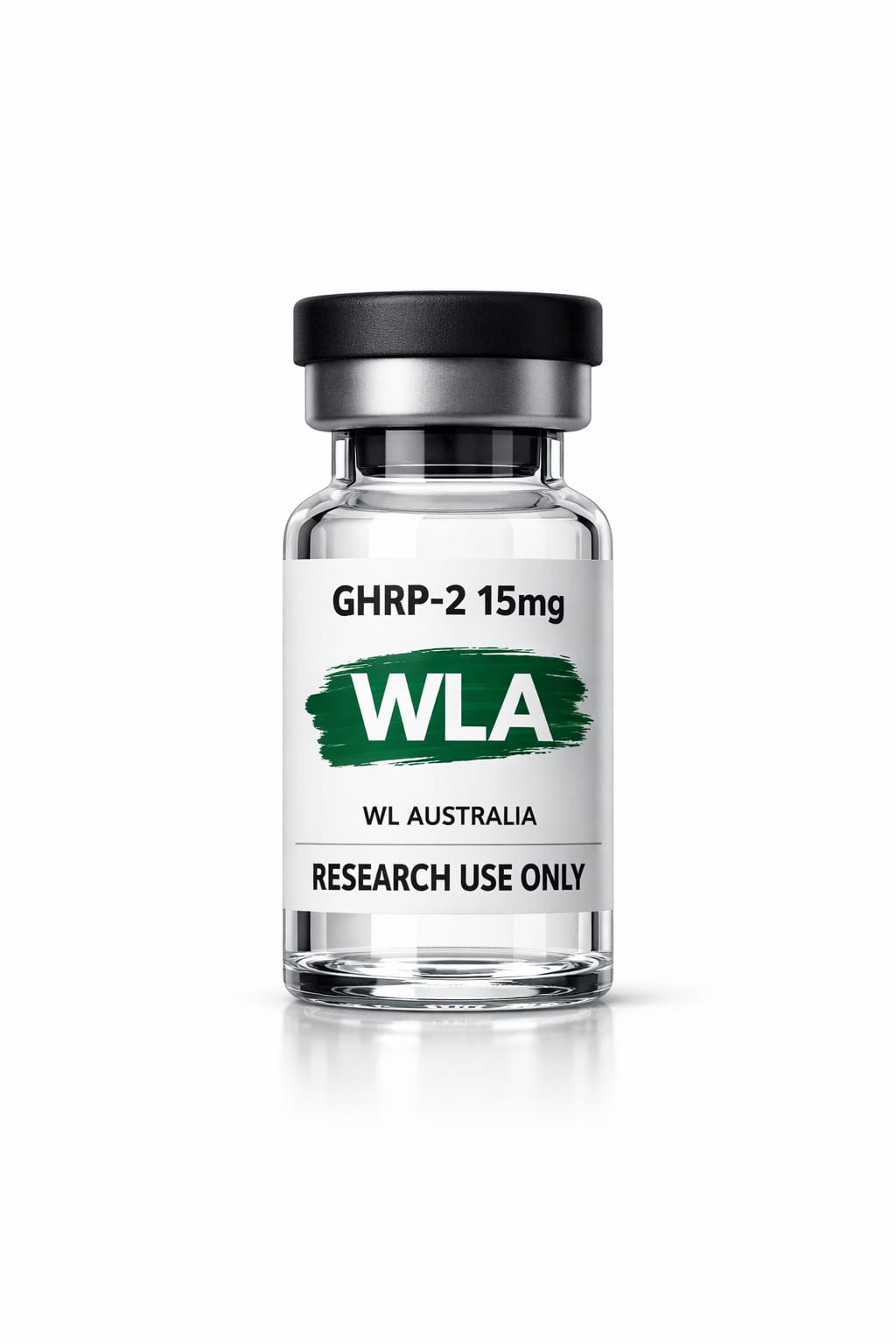
GHRP2 15mg
$70.00
In stock
Research chemical only- Not for human use.
GHRP-2 (also known as KP 102) is a synthetic hexapeptide Growth Hormone Releasing Peptide (GHRP), which acts on the hypothalamus and the pituitary gland to release growth hormone with a slight stimulator effect on Prolactin, ACTH and Cortisol levels. GHRP-2 is considered to be a true hGH secretagogue, meaning that it stimulates the body’s own secretion of hGH. Human Growth hormone has been shown in studies to promote lean body mass and reduce adiposity (fat). GHRP2 has demonstrated that it is very effective at stimulating GH production in research test subjects. It has a short half life with peak concentrations occurring around 15 minutes and not longer than 60 minutes after administration.
GHRP-2 and GRF Analogue Interactions (CJC-1295 / Sermorelin)
It is important to know that GHRP-2 does not relate to any Growth Hormone Releasing Hormones (GHRH) peptides such as Sermorelin and CJC-1295 because it acts on different receptors. However, greater results occurred when administered in conjunction with a Growth Hormone Releasing Hormone (GHRH) such as Modified GRF 1-29 or CJC-1295 DAC. Naturally, these GHRP-2 peptide receptors interact with a hormone called ghrelin. Growth hormone releasing peptide 2 is a commercially synthesized, non-natural super-analog of GHRP-6 which is capable of potent stimulatory effect on growth hormone (GH) secretion with slight stimulator effect in PRL, ACTH and levels of cortisol (Arvat et al. 1997). It is also a synthetic agonist of ghrelin that is binding with the growth hormone (GH) secretagogue receptor. GHRP-2 has been shown to affect and induce growth hormone secretion. The response of natural physiologic system includes increase in levels of calcium ion influx alongside with increased release of growth hormones in response to this peptide (Wu et al. 1994).
Comparing GHRP-2 and GHRP-6 (Growth Hormone Releasing Hexapeptide)
GHRP-2 is a 2nd generation GHRP just behind GHRP-6. Compared to GHRP-6, GHRP-2 is considered to be much more superior in terms of growth hormone stimulation because over longer periods of time it maintains maximum elevations in Growth Hormone. GHRP-2 has shown to increase IGF-1 levels (Insulinlike Growth Factor 1), and even greater results happen when used with Growth Hormone Releasing Hormone (GHRH). It has a short half life with peak concentrations occurring around 15 minutes but not longer than 60 minutes. The response of natural physiologic system includes increase in levels of calcium ion influx alongside with increased release of growth hormones in response to the high-amplitude pulsation from the GHRP-2. GHRP-2 and other ghrelin analogues increase the number of somatotropes involved in the GH pulse by inhibiting somatostatin, GHRH increases the pulse amplitude per pituitary cell or somatotrope by other means. Unlike ghrelin, GHRP-2 is not lipogenic which means that it does not induce fat storage. Although ghrelin plays a large role in hunger, GHRP-2 as an analog of ghrelin does not increase appetite significantly.
The Utility of GHRP-2 as a Growth Hormone Secretagogue
GHRP-2 has been studied extensively for its utility as a growth hormone secretagogue (GHS). Scientists have discovered that the Growth Hormone Releasing Peptide-2 increases the natural production of growth hormone (GH). In the early 90’s, one of the most famous studies was performed and later published in 1997 in the Journal of Endocrinology and Metabolism. This study further exemplifies the theory that growth hormone releasing peptides (including Ipamorelin and GHRP-6) could help hormone deficient adults and children. Ever since these major scientific studies, GHRP-2 has been widely produced. With other scientific labs confirming the results from their studies, GHRP-2 can in fact work for those who lack the ability to make adequate human growth hormone. Results however will differ with the use of GHRP-2 because species respond differently based on the pituitary somatotrophs and the differences in the subtypes of GHRP receptors. In the physiologic system, the actions are blocked by GRF receptors antagonist which acts through a different receptor to that employed by earlier GHRPs.
Set Aside for Scientific Research
It should be emphasized that despite the extensive amount of research and study that has been conducted in order to pinpoint the functionality and mechanics of GHRP – 2, it is only intended for the sole use of scientific study at this time. Because of this, any findings or observations that can be tied to GHRP – 2’s overall functionality, mechanics, benefits, should exclusively be the product of study performed in a strictly contained environment.
This product is sold as a research chemical only and not for human use
Legally we don’t provide directions on how this compound is taken nor what it should or should not be used for, we are selling this chemical compound solely as a chemical compound and not as a medicine, food, therapeutic good.
GHRP-2, an acronym for Growth Hormone-Releasing Peptide-2, represents a quintessential exemplar of synthetic ghrelin mimetics, operative in the pharmacological modulation of the anterior pituitary secretion of human growth hormone (hGH). This tri-peptide, characterized by its robust amino acid composition and structural mimicry to natural ghrelin, engages the growth hormone secretagogue receptor (GHSR) with a high affinity, thus instigating a cascade of intracellular signaling pathways that culminate in the subsequent secretion of hGH.
The mechanistic underpinnings of GHRP-2’s action can be explicatively elucidated through the lens of neuroendocrine regulation, wherein the peptide engenders a synergistic release of hGH in response to a variety of stimuli, both endogenous and exogenous. This orchestrated release is facilitated not only through hypothalamic stimulation — promoting the release of ghrelin and growth hormone-releasing hormone (GHRH) — but also via the attenuation of somatostatin, a potent inhibitor of hGH secretion. The pharmacodynamic properties of GHRP-2 underscore its significance within somatotropic axis dynamics, imbuing it with potential therapeutic applications ranging from anabolic steroid adjuncts to interventions in growth deficiencies and age-related somatopause.
Furthermore, the implications of chronic exposure to GHRP-2 warrant meticulous exploration within the context of longitudinal endocrine health. The peptide’s propensity to modulate the somatic proliferation and metabolic homeostasis presents an intriguing paradigm for understanding the interplay between exogenous peptide administration and endogenous hormonal milieu. Thus, GHRP-2 serves not only as a pivotal subject of inquiry within the realm of endocrinological therapeutics but also as a catalyst for broader discussions concerning peptide pharmacology and the intricate realm of neuroendocrine network interactions.
We will not tell you what to do with it.


 Immune Support and Life Extension
 Shop Bioregulators & Research Chemicals for 2026 Scientific Labs
 Brain
Brain Buy Hair & Skin Care Peptides Australia – Top Quality & Best Prices
 Discover WLAustralia Peptides for Anxiety Relief & Longevity


Reviews
Clear filtersThere are no reviews yet.