

The Final Word: Discipline, Responsibility & Your Path Forward in Peptide Research

You have reached the summit. Over the last eleven articles, we have deconstructed the complex world of peptide research, from the microscopic mechanisms of cellular repair to the legal frameworks governing local Australian laboratories. This final entry, Article 12, is the capstone of The Responsible Researcher Series. It is time to move from theory to implementation.
In this field, knowledge without discipline is like a high-performance sports car without a steering wheel: it looks impressive, but it’s destined for a crash. You will learn how to audit your own readiness, master the "math baseline," and recognize the moment when the most responsible action is to step back.
Evaluating Your Effort Levels: The Maintenance Analogy
The Problem: Many researchers start with high enthusiasm but low consistency. They treat bio-optimization like a light switch they can flick on and off, leading to plateaued results and wasted resources.
The Solution: You must view your research as a construction project. If the site foreman (you) only shows up half the time, the building will be structurally unsound. High-level research requires a "maintenance" mindset rather than a "fueling" mindset.
Consider a car engine. You can put the highest quality fuel into the tank, but if you ignore the oil changes and timing belt, the engine will eventually seize. Similarly, when using tools like natural health supplements or experimental peptides, your effort must extend beyond the "fuel" (the compound). It must include the "maintenance": the rigorous tracking of variables, sleep optimization, and blood chemistry monitoring.
- Audit your schedule: Do you have the time to document every observation?
- Audit your environment: Is your workspace ready for clinical-level sterility?
- Audit your intent: Are you looking for a shortcut, or are you building a foundation?
The Non-Negotiable Math Baseline
The Problem: Scientific errors are rarely caused by a lack of "vision"; they are caused by a misplaced decimal point. Guesswork in reconstitution or dosing is the fastest way to compromise data and safety.
The Solution: You must master the math before you touch the hardware. This is your "blueprint." If a builder miscalculates the load-bearing capacity of a beam by 10%, the roof collapses. In peptide research, a 10x error in concentration (moving from micrograms to milligrams) can have profound physiological consequences.

Focus on the following mathematical pillars:
- Unit Conversion: Understand the leap from mg to mcg. There are 1,000 micrograms in a milligram. Memorize this.
- Concentration Calculations: If you add 2mL of bacteriostatic water to a 5mg vial, your concentration is 2.5mg/mL.
- The "Tick Mark" Logic: On a standard insulin syringe, every small tick might represent a specific unit of volume. You must know exactly what that volume represents in terms of your active compound.
Take Control: Never "eyeball" a dose. Use a calculator, write your math down, and check it twice. If the math doesn’t make sense on paper, it won’t make sense in the vial.
The Danger of Laziness: The Zipper Effect
The Problem: Laziness in research often manifests as "cutting corners": reusing consumables, skipping the sanitation step, or failing to maintain a cold chain for storage.
The Solution: Think of your research protocol like a zipper. For a zipper to function, every single tooth must align perfectly. If even one tooth is bent or missing: due to laziness or neglect: the entire mechanism fails. The zipper splits open, and the contents are lost.
Laziness is the single greatest risk factor in any laboratory setting. Whether you are researching best vitamins for energy or complex bioregulators, the rules of sterility and storage are non-negotiable.
Core Disciplines for the Responsible Researcher:
- Cold Chain Integrity: Peptides are fragile proteins. Heat is their enemy.
- Single-Use Protocols: Never compromise on needles or syringes.
- Surface Sanitization: Your workspace should be more akin to a surgical suite than a kitchen counter.
Hardware and Workspace Precision
The Problem: A cluttered or unorganized workspace leads to contamination and cross-reactivity. If your tools are scattered, your focus will be too.
The Solution: Invest in a dedicated research environment. Using an all-in-one peptide kit can help streamline this process by providing a structured set of tools designed to work together.
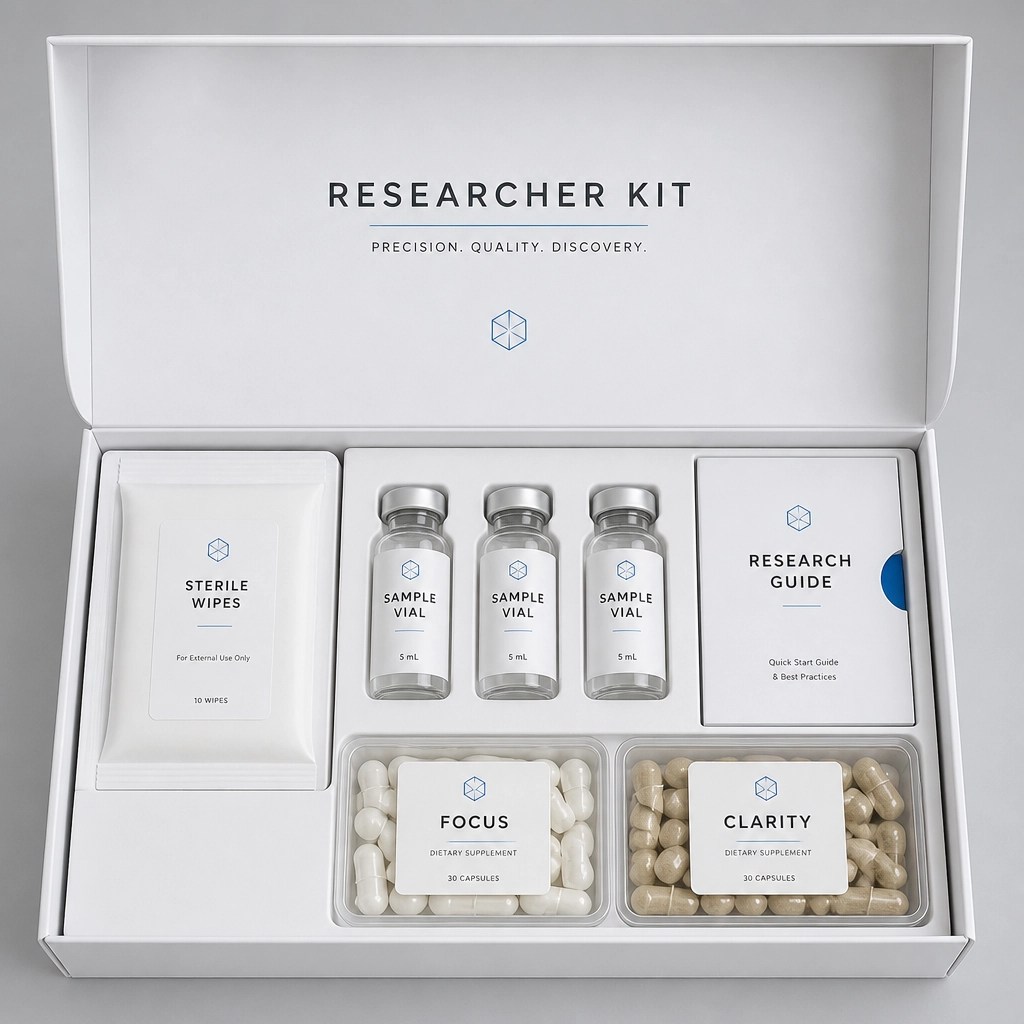
Workspace Checklist:
| Component | Requirement | Purpose |
|---|---|---|
| Surface | Non-porous (Stainless steel/Glass) | Prevents bacterial growth |
| Lighting | High-intensity LED | Ensures visibility for air bubbles/particles |
| Storage | Medical-grade refrigeration | Maintains peptide stability |
| Waste | Sharps container | Essential for safe disposal |
Assessing Your Discipline: Recognizing When to Step Back
The Problem: The desire for results can sometimes blind a researcher to their own lack of preparedness or the emergence of "red flag" data.
The Solution: Adopt the role of a Mentor. If you were advising a student who was exhausted, unorganized, or ignoring safety protocols, what would you tell them? You would tell them to stop.
Key Indicators You Are NOT Ready:
- You cannot explain the mechanism of action of the compound you are studying.
- You haven't performed a baseline blood panel in the last 6 months.
- Your workspace is shared with food or domestic activities.
- You are rushing the process to meet an arbitrary deadline.
Key Indicators of Preparedness:
- You have a dedicated logbook with dates, lot numbers, and observations.
- You understand the local Australian regulations regarding "Research Use Only" compounds.
- You have a contingency plan for adverse reactions.
Mastering the Core Principles: A Series Recap
As we conclude this series, remember the "Three Pillars of the WLA Researcher":
- Synergy: No compound works in a vacuum. Your internal biology: your gut health and metabolic status: determines the outcome.
- Recovery: Research is a stressor. Optimization is only possible when the body has the resources to adapt.
- Optimization: This is a marathon, not a sprint. Small, incremental gains are safer and more sustainable than radical, unmonitored shifts.

Implementing Your Knowledge: The Path Forward
The information you have gathered over these 12 articles is a powerful toolset. But a toolset is useless if it sits in the garage gathering dust. You must now take this knowledge and implement it with the gravity it deserves.
Start by auditing your current health stack. Are you utilizing nootropics to support cognitive clarity during your research? Are you ensuring your foundational micronutrients are addressed before moving to advanced peptides?
The Responsibility of the Researcher:
You are the architect of your own biology. This is an empowering reality, but it comes with the heavy burden of responsibility. You are responsible for the math. You are responsible for the sterility. You are responsible for the outcomes.
Take Action:
If you are ready to commit to the highest standards of research, ensure your laboratory is stocked with the right hardware and your protocols are verified. The path to optimization is open: walk it with discipline.
Key Takeaways for Safe Practice
- Math is Safety: A decimal point error is a safety failure.
- Environment is Control: A clean workspace is a valid workspace.
- Discipline is Result: Consistency beats intensity every single time.
- Responsibility is Final: You own the data, and you own the risk.
Disclaimer: This article is for informational and research purposes only. Peptides and research chemicals are not intended for human consumption unless otherwise specified by local regulatory bodies. Always consult with a qualified medical professional before making changes to your health regimen.


 Are Scientific Research Immune Support Products Effective?
 Are Research Chemicals & Bioregulators the Future of Scientific Labs 2026?
 Brain
Brain Are Skin & Hair Care Products Australia the Best Choice for You?
 Are WL Australia Peptides Helping with Anxiety & Longevity?


