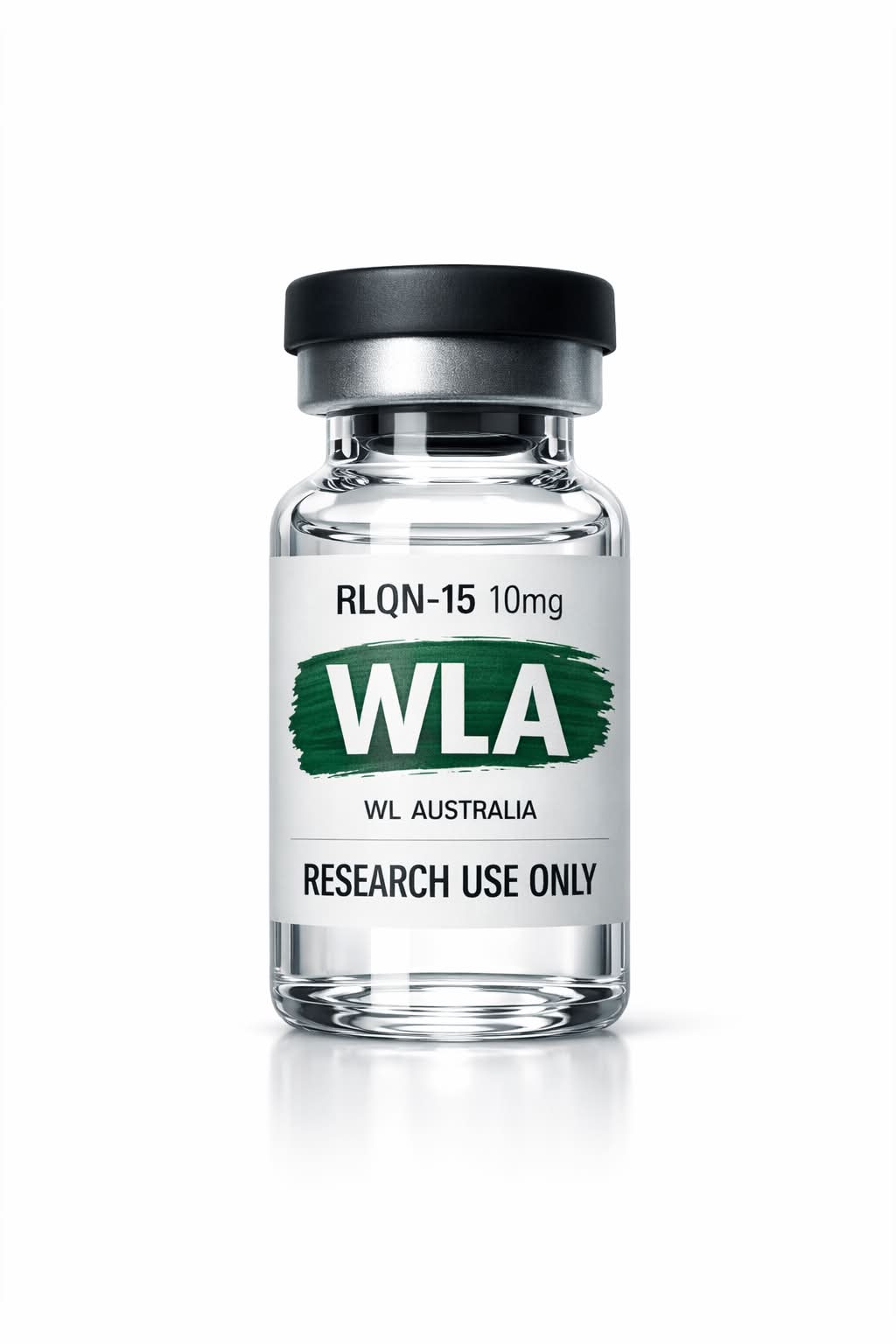
RLQN-15: The Research Peptide for Targeted Cellular Signaling

In the high-stakes world of biological research, communication is everything. Imagine a massive construction site where the plumbers, electricians, and carpenters have lost their radios. The building might still go up, but the timing is off, the wires are crossed, and the progress is agonizingly slow. This is exactly what happens in your body during a "stalled" healing process. Your cells are ready to work, but the signaling: the "radio chatter": has gone silent.
RLQN-15 is the high-frequency radio of the peptide world. As a pro-regenerative heptapeptide (a short chain of seven amino acids), it is specifically designed to re-establish these vital communication lines. You will learn how this research tool targets the "blueprints" of cellular repair, potentially unlocking new pathways for skin recovery and nerve regeneration.
The Origin of the Signal: What is RLQN-15?
RLQN-15 is an amphibian-derived peptide that has recently surged to the forefront of regenerative science. While traditionally "healing" was thought to be a simple matter of providing enough raw materials (like protein and vitamins), modern research focuses on cellular signaling.
Consider the engine of a high-performance car. You can have all the fuel (nutrients) and air (oxygen) in the world, but if the ECU (Engine Control Unit) isn't sending the right spark signal at the right microsecond, the car won't move. RLQN-15 acts on the "ECU" of your cells, specifically targeting receptors that tell the body to accelerate repair.

The Problem: When the "Spark" Fails
Many researchers face a common frustration: the "plateau." Whether it is a chronic skin issue that refuses to close or a nerve that remains dormant after an injury, the biological machinery is often stuck in a loop of inflammation. This is particularly prevalent in metabolic conditions where high glucose levels act like "mud" in the communication lines, slowing down every signal.
The Solution: RLQN-15 targets three distinct biological "repair crews" to get the job done:
- Keratinocytes: These are your primary skin-building cells. RLQN-15 acts like a megaphone, telling these cells to proliferate and migrate to the site of "damage" faster than they would on their own.
- Epidermal Stem Cells: Every construction site needs a foreman. These stem cells hold the original blueprints. RLQN-15 activates the Wnt/β-catenin axis, which is essentially the "Go" signal for stem cell activation.
- Vascular Endothelial Growth Factor (VEGFB): No repair happens without blood flow. RLQN-15 helps bypass the "mud" of inflammation to up-regulate the signals that build new micro-vessels.
Nerve Fiber Regeneration: Repairing the Fiber Optic Cables
Perhaps the most exciting frontier of RLQN-15 research is its effect on nerve fibers. Think of your nerves as a complex network of fiber-optic cables carrying data from your brain to your skin and muscles. When these cables are frayed, the data stops. You lose sensation, coordination, and the ability to heal properly.
Research has shown that RLQN-15 treatment can increase axonal plasticity. In plain English, it helps the "cables" find new routes and grow longer. By activating the PI3K/Akt pathway: a survival and growth circuit: RLQN-15 helps protect neurons from dying and encourages them to "re-wire" the damaged area.

Focus your attention on the concept of synergy. Many researchers combine RLQN-15 with other recovery-focused peptides. For instance, pairing it with BPC-157 or TB-500 may provide a multi-layered approach to systemic repair, where one handles the structural integrity and the other (RLQN-15) manages the specific cellular signaling.
The Molecular "Zipper": How It Actually Works
To understand RLQN-15, you must understand the Frizzled-8 (FZD8) receptor. Think of this receptor as a specialized zipper on the surface of a cell. When the right "teeth" (the RLQN-15 peptide) lock into the zipper, it opens up a pathway that allows the cell to read the "regeneration" chapter of its DNA.
Once the zipper is open, the Wnt/β-catenin pathway kicks in. This is a sequence of events where a protein called β-catenin travels into the nucleus of the cell to turn on the "lights." These lights represent genes like MYC and CCND1, which are responsible for cell division. Without this signal, the cell stays in a "resting" state, even if there is work to be done.
[Video Placeholder: Animation of the Wnt/β-catenin Signaling Pathway]
Practical Safety and Maintenance
When working with advanced research peptides like RLQN-15, precision is your most important tool. Like a high-end laboratory instrument, these compounds require specific handling to maintain their "signal strength."
Reconstitution and Storage
Most research peptides arrive as a lyophilized (freeze-dried) powder. To activate them, you must perform "reconstitution": the process of turning the powder back into a liquid solution.
- The Solvent: Always use Bacteriostatic Water to ensure the solution remains sterile.
- The Technique: Never "shake" the vial. Think of the peptide chains as delicate glass ornaments; if you shake them, they shatter (denature). Instead, gently swirl the vial until the solution is clear.
- Storage: Once reconstituted, the "radio signal" begins to fade. Store your vials in a dark, refrigerated environment between 2°C and 8°C. For more detailed instructions, consider reading our Step-by-Step Guide to Reconstitution.

The Australian Context: Research and Compliance
In Australia, the landscape for research peptides is highly regulated. It is essential to ground your research in a sense of responsibility. RLQN-15 is currently classified as a research chemical. This means it is intended for laboratory research and "in vitro" (test tube) or "in vivo" (animal model) studies to further our understanding of cellular signaling.
As an authoritative guide in this space, wlaustralia emphasizes that any application of these findings must be done under strict medical oversight and within the legal frameworks of the Therapeutic Goods Administration (TGA). Taking control of your biology starts with education, but it is sustained by safety.
Summary: Unlocking Your Biological Potential
RLQN-15 represents a shift from "brute force" healing to "intelligent" signaling. By understanding the analogies of the construction site and the fiber-optic cable, you can better appreciate the sophistication of this heptapeptide.
| Feature | Function | Analogy |
|---|---|---|
| FZD8 Binding | Initiates Signal | Locking the Zipper |
| Wnt/β-catenin | DNA Transcription | Reading the Blueprints |
| PI3K/Akt | Nerve Survival | Powering the Cables |
| VEGFB Up-regulation | Angiogenesis | Building the Supply Road |
[Video Placeholder: Interview with a Peptide Researcher on Targeted Signaling]
If your research involves the limits of recovery and the optimization of cellular communication, RLQN-15 is a tool that demands your attention. Whether you are looking at advanced healing blends or solo product spotlights, the goal remains the same: to turn the "static" of injury back into the "symphony" of health.

Consider this the beginning of your journey into targeted cellular signaling. The tools are here; the signal is clear. Are you ready to listen?

 Immune Support and Life Extension
 Khavinson Bioregulators
 Brain
Brain Skin & Hair Care Peptides
 Anxiety & Mental Health