

AHK-Cu: The Copper Peptide Built Specifically for Hair Growth

Hi Mate! Matt here from the WeightLossChems research team.
If you’ve been navigating the world of biohacking and "follicular rejuvenation" for a while, you’ve likely crossed paths with copper peptides. Usually, the conversation starts and ends with GHK-Cu: the legendary "Blue Peptide" known for skin remodeling and systemic healing. But if your research is laser-focused on the scalp, there is a more specialized tool in the kit: AHK-Cu.
While GHK-Cu is a jack-of-all-trades for anti-aging, AHK-Cu (L-alanyl-L-histidyl-L-lysine-Cu2+) is the specialist built for one primary mission: to Unlock the growth potential of the human hair follicle.
Today, we’re diving deep into the clinical mechanisms of AHK-Cu, how it targets the "command center" of your hair, and why it’s becoming the go-to for serious hair growth research.
The Scientific Luxury of AHK-Cu
AHK-Cu is a tripeptide-copper complex that sits at the intersection of high-end beauty and advanced metabolic research. Unlike basic topical treatments, AHK-Cu operates at a cellular level, influencing the very pathways that determine whether a hair follicle stays in the growth phase (Anagen) or enters the resting phase (Telogen).
In the research community, we refer to this as a "targeted metabolic activator." It’s not just about "feeding" the hair; it’s about Transforming the biological environment of the scalp to favor density and length.
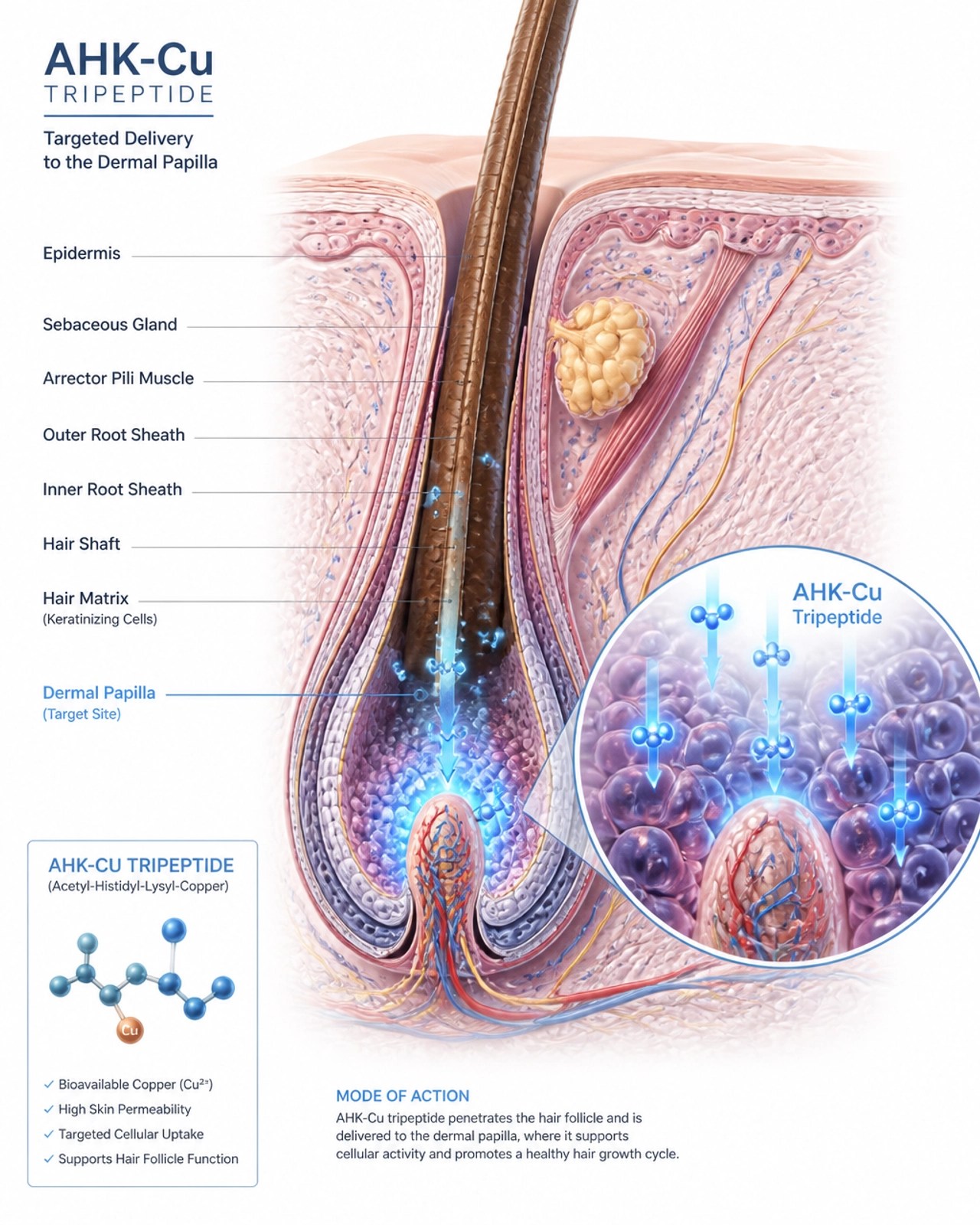
Mechanism #1: Dermal Papilla Cell Proliferation
At the base of every hair follicle lies the Dermal Papilla (DP). Think of the DP as the "brain" of the hair. It sends signals to the surrounding cells to divide, grow, and produce a hair shaft.
The most exciting research surrounding AHK-Cu centers on its ability to stimulate Dermal Papilla Cell (DPC) proliferation. In published ex-vivo studies, AHK-Cu was shown to significantly increase the number of these "command center" cells.
But it doesn’t just make more cells; it keeps them alive. AHK-Cu has been found to:
- Combat Apoptosis: It prevents programmed cell death in the hair follicle.
- Upregulate Bcl-2: This is an anti-apoptotic protein that signals the follicle to keep growing.
- Reduce Caspase-3: By lowering this "death enzyme," AHK-Cu protects the follicle from premature shedding.
Mechanism #2: Follicle Elongation and VEGF Upregulation
If you want longer, thicker hair in your research models, you need Follicle Elongation. This is where AHK-Cu truly shines compared to other peptides.
By upregulating Vascular Endothelial Growth Factor (VEGF), AHK-Cu promotes angiogenesis: the creation of new blood vessels. In the scalp, more blood vessels mean a higher delivery of nutrients and oxygen directly to the root.
Imagine the follicle as a high-performance engine. VEGF is the upgraded fuel line that ensures the engine never runs lean. When combined with the reduction of TGF-β1 (a growth inhibitor often linked to hair thinning), the result is a physiological "green light" for growth.

AHK-Cu vs. GHK-Cu: Which One for Your Research?
We often get asked in the VIP Club chat: "Matt, why should I choose AHK-Cu over the classic GHK-Cu?"
The answer lies in specialization:
- GHK-Cu: The "Generalist." Excellent for skin elasticity, wound healing, and general anti-aging. It’s a must-have for a youthful complexion, but its hair growth effects are often secondary to its skin-remodeling properties.
- AHK-Cu: The "Specialist." This peptide was specifically screened for its affinity for epithelial tissues and follicular cells. If the goal is strictly hair growth research, AHK-Cu is functionally superior because of its focused action on DPC proliferation and VEGF expression.
Integrating AHK-Cu Into Your Research Protocol
Researching AHK-Cu requires precision. Most lab models utilize it in a topical formulation or as part of a specialized hair serum.
Because we believe in making research accessible, we provide the tools you need to bypass the technical hurdles:
- The Peptide Calculator: To ensure your concentrations are clinical-grade, use our Peptide Calculator tool. Accuracy is the difference between "vibrant results" and wasted research.
- Research Supplies: Always pair your peptides with high-quality Bacteriostatic water and sterile kits, which you can find in our Supplies Section.
Research Concentration Notes
Clinical data suggests a very narrow, biphasic dose-response. In ex-vivo human follicles, the sweet spot for AHK-Cu was found to be between 10⁻¹² and 10⁻⁹ M. Going too high can actually lead to inhibitory effects, proving that in the world of high-tech peptides, "more" isn't always "better."
The "Problem-Solution" Framework for Scalp Health
- The Biological Need: Shrinking follicles and reduced blood flow (miniaturization).
- The High-Tech Solution: AHK-Cu targets the dermal papilla to reverse miniaturization and Revolutionize the growth cycle.
Whether you are a biohacker looking to maintain your edge or a researcher investigating the future of metabolic health, AHK-Cu represents the pinnacle of follicular science.
Final Thoughts from Matt
Researching hair health shouldn't be a guessing game. By utilizing targeted tripeptides like AHK-Cu, we can move beyond old-school "remedies" and start working with the body’s own signaling pathways.
If you have questions about AHK-Cu or how it fits into your metabolic research, jump onto the site and chat with the WLC Assistant. We’re here to help you navigate the frontier of peptide science.
Stay sharp,
Matt
WeightLossChems Research Team


 Peptide Supplements & Research Peptides for Better Longevity
 Scientific Fitness & Laboratory Equipment by WL Australia
 Immune and life extension
 Bioregulators
 Brain
Brain Skin & Hair
 Immune and Life Extension Peptides for Anxiety Support

