
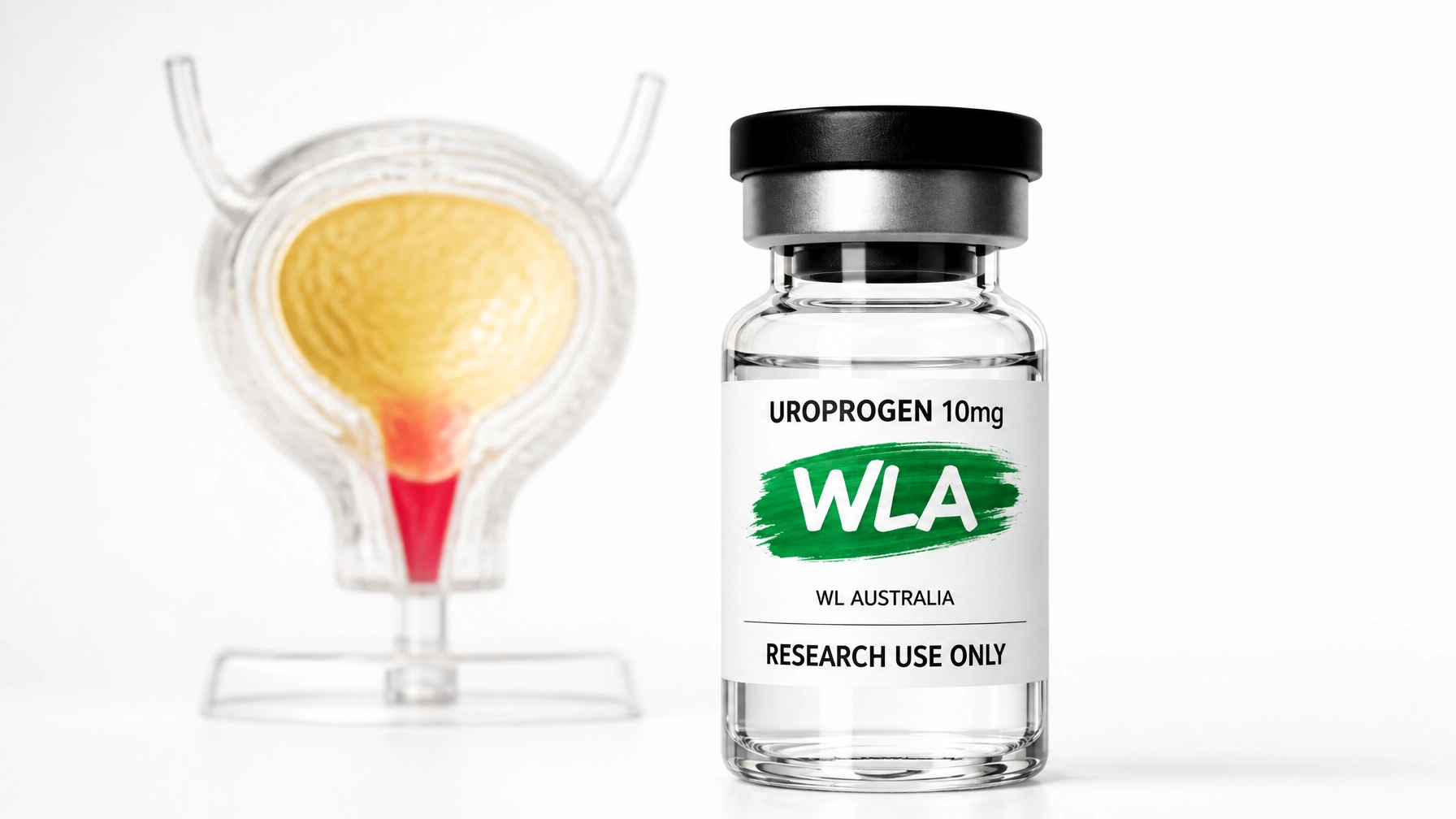
Bladder Control and Tissue Strength: How Uroprogen Supports the Urinary System

You do not usually think about your bladder until it interrupts your day. A sudden urge during a meeting, repeated bathroom visits on a long drive, or waking several times at night can make ordinary routines feel like a series of detours.
The bladder is more than a storage bag. It is a muscular pouch that must expand, hold urine, signal when it is full and contract at the right time to empty. When its tissues or control signals become less efficient, bladder capacity and control may change.
This article explains the bladder’s structure, why its smooth muscle can weaken, and how Uroprogen is positioned within peptide bioregulator research. It also explains how kidney-focused Pielotax differs from Uroprogen and why urinary symptoms should always be assessed by a qualified clinician.
Important safety note: Uroprogen is listed by WL Australia as a research chemical only: not for human use. It is not an approved medicine or established treatment for bladder weakness, urinary leakage, prostate disease or any other medical condition. Do not self-treat. Speak with a doctor before investigating persistent urinary symptoms.
The bladder: a muscular pouch with a precise job
The problem: storage and emptying must stay coordinated
Your bladder works like a flexible reservoir connected to a controlled outlet. It stores urine produced by the kidneys, then empties through the urethra when the nervous system and muscles coordinate correctly.
The main muscle in the bladder wall is called the detrusor. The detrusor is smooth muscle, meaning it works automatically rather than under the same conscious control as the muscles in your arms or legs.
A healthy bladder needs to perform two opposite tasks:
- Relax and expand as urine enters
- Contract and empty when urination is appropriate
Think of it like a team operating an automatic loading dock. One part must keep the doors closed while the storage area fills. Another part must open the exit at the right moment. If the timing becomes confused, you may experience urgency, frequency or incomplete emptying.
Short summary: bladder control depends on tissue strength, nerve signals and timing working together.
Why bladder tissue can weaken
The problem: age and life events may affect capacity and control
As you age, changes can occur in the bladder wall, pelvic tissues, nerves and surrounding structures. The bladder may become less flexible or more sensitive to filling. Its contractions may also become less predictable.
Life events can contribute as well. Pregnancy and childbirth may affect pelvic support. Pelvic surgery, hormonal changes, chronic constipation, changes in body weight and some neurological conditions can also influence bladder control.
For some people, the main issue is a weakened support system. For others, the bladder wall contracts too soon. This is sometimes described as overactive bladder, where involuntary detrusor contractions create a sudden urge to urinate.
Common symptoms may include:
- Frequent urination during the day
- Waking at night to urinate, known as nocturia
- Sudden urgency
- Urge-related leakage
- A reduced sense of bladder capacity
- Difficulty delaying urination
However, the same symptoms can have very different causes. A bladder is not an isolated component; it is one part of the wider urinary system.
The solution: first identify whether the main issue involves storage, emptying, urine production or an underlying medical condition. A symptom diary and clinical assessment can help separate these possibilities.

How Uroprogen is positioned in bioregulator research
The problem: conventional symptom descriptions do not explain tissue-level function
When you read about urgency or leakage, it is easy to focus only on the symptom. But the deeper question is what is happening in the tissue.
Peptide bioregulators are short chains of amino acids studied for their possible signalling effects. The basic concept is similar to sending a maintenance instruction to a construction site: the signal does not replace the workers or rebuild the entire building by itself, but it may help direct attention towards specific repair processes.
The foundational chapter presents Uroprogen as a peptide bioregulator designed to support repair of the bladder wall’s smooth muscle. In that research framework, its proposed role is to help restore:
- Smooth muscle structure
- Bladder wall strength
- Bladder storage capacity
- Coordinated contraction
- More controlled emptying
The theory is that healthier smooth muscle may help the bladder hold urine more effectively and reduce untimely contractions. In practical terms, the bladder may be viewed as a reservoir with a flexible wall. If that wall becomes weak, stiff or overreactive, the reservoir may signal “full” too early or contract before the right time.
But this remains an area for research. The WL Australia product page specifically labels Uroprogen “research chemical only: not for human use” and does not establish a validated human dose, course or treatment protocol.
Short summary: Uroprogen’s proposed research focus is bladder and lower urinary tract tissue: not self-treatment of urinary symptoms.
Bladder capacity and involuntary contractions
The problem: a bladder that signals too early can disrupt sleep and daily life
Imagine a sports team calling a timeout before the match has reached a critical moment. If bladder signals arrive too early, you may feel urgency even when the bladder has not stored a large volume of urine.
In the foundational model, Uroprogen is intended to support the detrusor and surrounding urinary tissues so the bladder can:
- Expand during filling
- Maintain storage for longer
- Signal fullness more appropriately
- Contract in a more coordinated way
- Empty with less disruption
This proposed mechanism is not the same as simply “holding more water.” Bladder capacity involves the interaction of tissue elasticity, nerve communication, pelvic floor support and outlet function.
For example, a person who wakes twice each night may have a storage problem, but they may also be producing too much urine overnight. Caffeine, alcohol, evening fluids, diabetes, sleep apnoea, medication timing and kidney or heart conditions can all contribute to nocturia.
The Australian Government’s Healthdirect guidance on frequent urination recommends medical assessment when frequent urination affects normal activities or when you regularly wake more than once at night. A clinician may consider urine tests, blood tests, an ultrasound or a bladder diary.
The practical lesson: improving tissue resilience is only one part of bladder care. Correct diagnosis comes first.
Video placeholder 1: How the Bladder Stores and Releases Urine
[Insert approved educational video here]
Uroprogen and Pielotax: two connected but different systems
The problem: kidney and bladder products can be confused
Your urinary system is like a water-treatment facility connected to a network of pipes and storage tanks.
- The kidneys filter blood, balance fluids and produce urine.
- The ureters carry urine from the kidneys to the bladder.
- The bladder stores urine.
- The urethra carries urine out of the body.
Uroprogen is positioned around bladder, prostate and lower urinary tract research. Pielotax is positioned around kidney and renal tissue research.
| Research focus | Uroprogen | Pielotax |
|---|---|---|
| Primary area | Bladder, prostate and lower urinary tract | Kidneys and renal tissue |
| Proposed theme | Smooth muscle, bladder function and urinary flow | Kidney-cell metabolism and fluid regulation |
| System role | Storage and outflow | Filtration and waste balance |
| Product status | Research chemical only: not for human use | Research chemical only: not for human use |
You can review the current Uroprogen 10mg product page and Pielotax 10mg product page. Product availability, descriptions and regulatory information may change.
The foundational chapter describes combining Uroprogen with Pielotax for broader renal-urinary support: Uroprogen focuses on the bladder and lower urinary tract, while Pielotax focuses on the kidneys. This is a conceptual research framework, not a recommendation to combine products or a treatment protocol.
Think in systems. A stronger storage tank does not automatically repair the filtration plant. Both areas need separate assessment.

A practical approach to nighttime urination
The problem: broken sleep can become a cycle
Waking to urinate can reduce sleep quality, concentration and daytime energy. It can also increase the risk of falls when you walk through a dark room.
Before considering any product, keep a 24- to 72-hour bladder diary. Record:
- What and when you drink
- Caffeine and alcohol intake
- Each urination and approximate volume
- Urgency or leakage
- Night-time awakenings
- Medicines and their timing
This diary works like a dashboard in a car. It gives your clinician more information than a single statement such as “I go often.”
While awaiting assessment, discuss sensible measures with your healthcare professional:
- Avoid excessive caffeine and alcohol, especially later in the day
- Do not severely restrict fluids without medical advice
- Address constipation
- Ask whether medication timing may contribute
- Keep a clear, well-lit path to the bathroom
- Consider pelvic floor physiotherapy where appropriate
If you have a prostate, weak flow, hesitancy or a feeling that the bladder does not empty fully should be assessed. If you have increased thirst, fatigue or large volumes of urine, ask about diabetes testing.
Short summary: track the pattern, identify the cause and protect sleep safely.
When to seek medical advice
Frequent urination, urgency, pain or leakage should not automatically be attributed to ageing or weak bladder tissue. Possible causes include:
- Urinary tract infection
- Bladder inflammation
- Enlarged prostate
- Diabetes
- Pregnancy or postpartum pelvic changes
- Medication effects
- Kidney disease
- Neurological conditions
- Sleep disorders
Seek prompt medical care if symptoms occur with fever, chills, vomiting, severe abdominal or back pain, blood in the urine, inability to urinate or sudden worsening. In Australia, you can contact Healthdirect on 1800 022 222 for general health advice, or arrange an appointment with your GP.
Uroprogen should not replace antibiotics for an infection, evaluation for prostate enlargement, diabetes management or treatment for kidney disease.
Video placeholder 2: Bladder Diaries, Urgency and When to Speak with a Clinician
[Insert approved educational video here]
Final perspective
Bladder control is a coordinated biological process. The bladder wall must stretch like a flexible storage tank, contract like a well-timed engine and communicate with the nervous system and pelvic floor.
Uroprogen is described in the foundational chapter as a peptide bioregulator designed to research smooth muscle repair, bladder capacity and involuntary contractions. Pielotax is positioned towards the kidney side of the same wider system. Together, they illustrate an important principle: target the right tissue, understand the evidence and maintain medical oversight.
For now, treat Uroprogen and Pielotax as research products only. Do not self-treat urinary symptoms. If your bladder is repeatedly interrupting your day or sleep, make the clinician’s assessment your first step.
Better understanding. Safer decisions. Stronger long-term health.


 Immune Support and Life Extension
 Shop Bioregulators & Research Chemicals for 2026 Scientific Labs
 Brain
Brain Buy Hair & Skin Care Peptides Australia – Top Quality & Best Prices
 Discover WLAustralia Peptides for Anxiety Relief & Longevity