

IGF-DES: The Potent IGF-1 Analog for Muscle Growth, Recovery and Tissue Repair

If you have ever felt like your progress in the gym has hit an invisible wall, or if a nagging injury has kept you on the sidelines for far too long, you are likely looking for a way to break through. In the world of high-performance physiology, standard recovery methods sometimes aren't enough. You need something that acts like a "High-Intensity General Contractor" for your body: someone who doesn't just show up to the job site, but brings a specialized crew to finish the work in record time.
That is where IGF-DES comes in.
IGF-DES (Insulin-like Growth Factor 1, Desamino) is a truncated, highly potent analog of the natural IGF-1 hormone produced by your liver. While your body naturally uses IGF-1 to manage growth and repair, IGF-DES is a modified version designed to bypass the usual cellular "red tape," allowing it to deliver a concentrated blast of regenerative power exactly where you need it most.
In this guide, you will learn the mechanics behind this powerful peptide, how it facilitates muscle hyperplasia, and how you can integrate it into a recovery strategy to unlock your full biological potential.
What is IGF-DES? The Science of the "Master Key"
To understand why IGF-DES is so effective, consider a standard IGF-1 molecule as a master key that fits into a lock (the IGF-1 receptor) on your muscle cells. However, in your blood, there are "security guards" called IGF-Binding Proteins (IGFBPs). These guards grab onto the standard IGF-1, preventing it from reaching the lock until the time is right.
IGF-DES is different. It has been "truncated": meaning the first three amino acids of the chain have been removed. This small structural change is like filing down the edges of the key so the security guards can no longer grab it.
The Potency Advantage
Because IGF-DES does not bind to these proteins, it is free to flood your muscle receptors immediately. Research suggests that this makes IGF-DES up to 10 times more potent locally than standard IGF-1.
Focus on this: While standard IGF-1 travels through your entire system like a broadcast signal, IGF-DES acts like a surgical strike. It has a very short half-life: roughly 20 to 30 minutes: meaning its effects are concentrated almost entirely in the specific tissue where it is active.

Problem: The "Hypertrophy Ceiling"
Most athletes are familiar with hypertrophy: making existing muscle fibers larger through weightlifting and nutrition. However, every human has a genetic limit to how large an individual muscle fiber can grow. Once you hit this ceiling, progress stalls.
Solution: Hyperplasia and Satellite Cell Activation
IGF-DES solves this by triggering a process called hyperplasia. If hypertrophy is like adding more furniture to a room to make it feel "fuller," hyperplasia is like adding an entirely new room to the house.
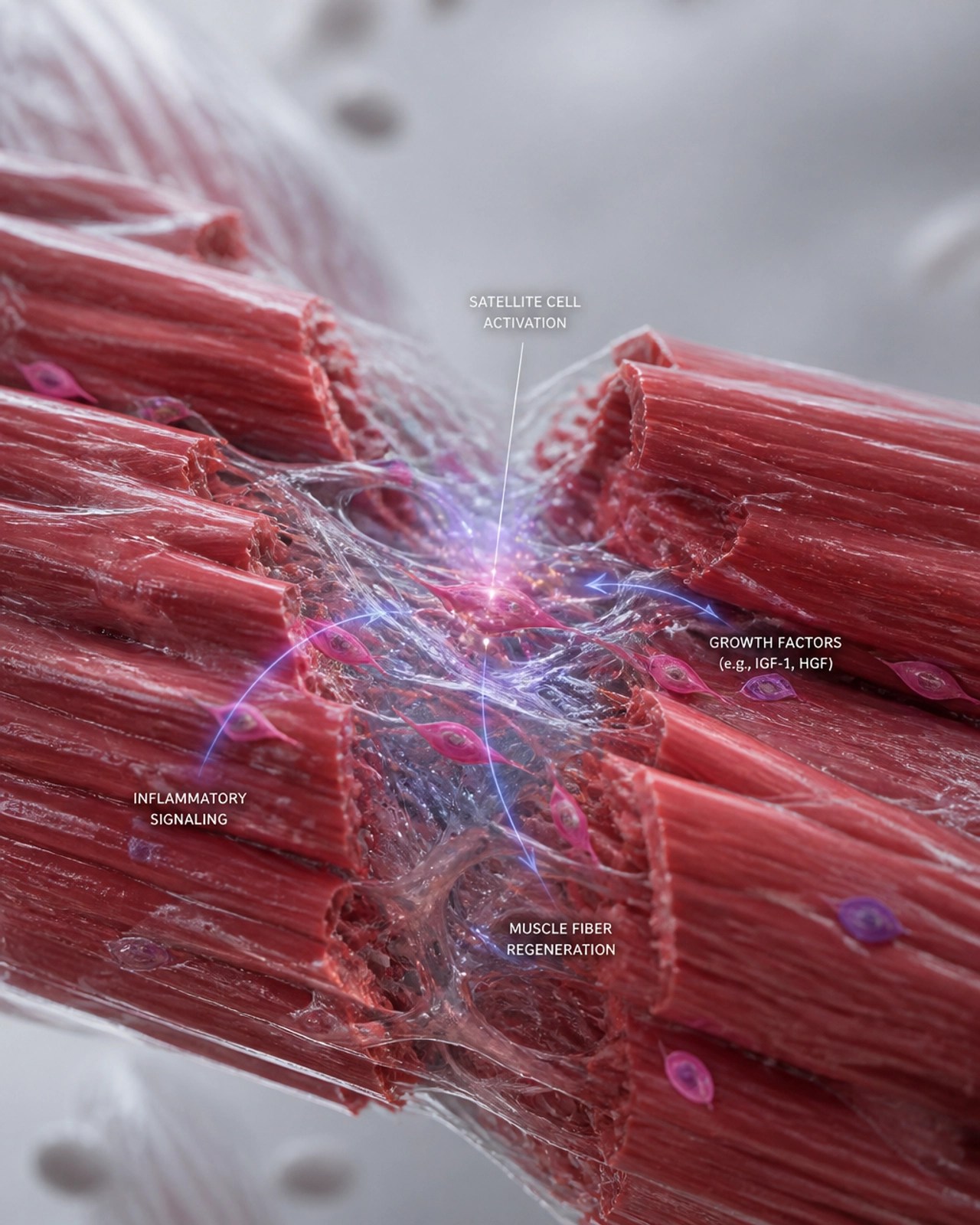
When you use IGF-DES, you are signaling to your satellite cells (muscle stem cells) to wake up and begin dividing. These new cells then fuse with your existing muscle fibers or form entirely new ones. This effectively raises your genetic ceiling, allowing for growth that was previously impossible.
Consider this tiered strategy for muscle optimization:
- Stimulus: High-intensity resistance training.
- Signaling: IGF-DES activation of the mTOR pathway.
- Result: Increased protein synthesis and new fiber formation.
Looking for more ways to optimize your physical performance? Check out our Shop All section for a full range of research-backed supplements.
Recovery and Tissue Repair: The Rapid Response Crew
Muscle growth is only one side of the coin. For many in the 20-to-60 age bracket, the primary frustration isn't just growth: it’s recovery. As we age, our "construction crew" slows down. Injuries to tendons, ligaments, and connective tissues take longer to heal because these areas have poor blood flow compared to muscle.
The Repair Mechanism
IGF-DES doesn't just bind to muscle receptors; it also seeks out receptors in your tendons and ligaments. By flooding these areas with growth signals, it accelerates:
- Collagen Synthesis: The "glue" that holds your joints together.
- Angiogenesis: The formation of new blood vessels to bring nutrients to the injury site.
- Cell Proliferation: Rapidly replacing damaged cells with healthy ones.
Synergy with Other Peptides
While IGF-DES is a powerhouse on its own, it often works best as part of a team. For those dealing with chronic injuries, many researchers look at the synergy between IGF-DES and recovery specialists like BPC-157 or TB-500.
If IGF-DES is the general contractor, BPC-157 is the site foreman who stops the bleeding and clears the debris, and TB-500 is the architect who ensures the new tissue is laid down in a flexible, functional pattern.
Technical Specifications: IGF-DES at a Glance
To help you digest the data, we have structured the core characteristics of IGF-DES into the table below:
| Feature | Specification | Impact on You |
|---|---|---|
| Molecule Type | Truncated IGF-1 (1-3) | Bypasses binding proteins for 10x potency. |
| Half-Life | 20–30 Minutes | Extremely localized, site-specific action. |
| Primary Goal | Hyperplasia & Repair | Creation of new muscle cells and rapid tissue healing. |
| Binding Affinity | High (IGF-1 Receptors) | Immediate activation of mTOR and PI3K/Akt pathways. |
| Best Timing | Post-Workout | Targets receptors when they are most sensitive. |
Practical Maintenance: Dosage and Timing
When it comes to advanced biology, timing is everything. Because IGF-DES has such a short "shelf-life" once it enters the body, you must be strategic.
The Post-Workout Window
The most effective time to utilize IGF-DES is immediately after training. During exercise, your muscle receptors become highly sensitized and "hungry" for growth signals. By introducing IGF-DES during this 20-minute window, you ensure the peptide hits the receptors before it is metabolized.
Instructional Guide:
- Target the Trained Muscle: Because of its localized nature, researchers often focus on the specific muscle group trained that day (e.g., chest, quads, or biceps).
- Bilateral Application: If you are targeting a paired muscle group, ensure the application is split evenly to maintain symmetry.
- Dosage Ranges: Common research protocols often cite ranges between 50mcg and 150mcg per session, though this must always be guided by professional oversight.
Note: For a deeper dive into how to manage injuries using these tools, read our Peptides for Injury Management: A Complete Guide.
[VIDEO PLACEHOLDER: The Science of IGF-1 Receptors and Muscle Growth]
Safety, Compliance, and the Australian Context
At wlaustralia, we prioritize your safety and legal standing above all else. It is vital to understand that in Australia, IGF-1 analogs and related growth factors are strictly regulated.
Regulatory Oversight
Under the Therapeutic Goods Administration (TGA), these substances are generally classified as prescription-only medicines. Furthermore, for competitive athletes, IGF-1 and its analogs are listed on the WADA (World Anti-Doping Agency) prohibited list.
Why Medical Oversight is Non-Negotiable
You are dealing with powerful biological signals. Using these tools without a doctor’s supervision is like trying to fly a jet without a pilot's license. Potential risks include:
- Hypoglycemia: Insulin-like growth factors can affect blood sugar.
- Joint Pain: Rapid growth in muscle can sometimes outpace the strengthening of tendons if not managed correctly.
- Unwanted Growth: Because IGF-1 stimulates cell division, it should never be used by individuals with a history of certain medical conditions (like cancer) without extreme caution.
Take control of your health by being informed. Always consult with a healthcare professional who understands alternative medicines before starting any new protocol.
Conclusion: Unlocking Your Potential
IGF-DES represents a fascinating frontier in human biology. By shortening the protein chain, science has created a way to bypass the body's natural inhibitors, delivering a concentrated growth signal exactly where it is needed most. Whether you are looking to overcome a genetic plateau through hyperplasia or fast-track the repair of a stubborn injury, the "High-Intensity General Contractor" offers a path to optimization.
Remember, biology is a marathon, not a sprint. By combining advanced signaling tools like IGF-DES with foundational nutrition, proper training, and professional guidance, you can take control of your recovery and build a stronger, more resilient version of yourself.
Ready to Learn More?
Explore our extensive library of resources, including The Complete Guide of Nootropic Peptides for mental clarity, or browse our full product range to find the right support for your wellness journey.


 Immune Support and Life Extension
 Khavinson Bioregulators
 Brain
Brain Skin & Hair Care Peptides
 Anxiety & Mental Health


