Bronchogen: The Lung Bioregulator Peptide for Respiratory Support and Immune Defense

Breathing is automatic, but healthy respiratory function depends on a complex biological system working in sync. Your bronchial tubes, lung tissue, mucus layer, cilia and local immune defences operate like a well-managed filtration plant. Each part has a specific job, and problems in one area can place extra pressure on the others.
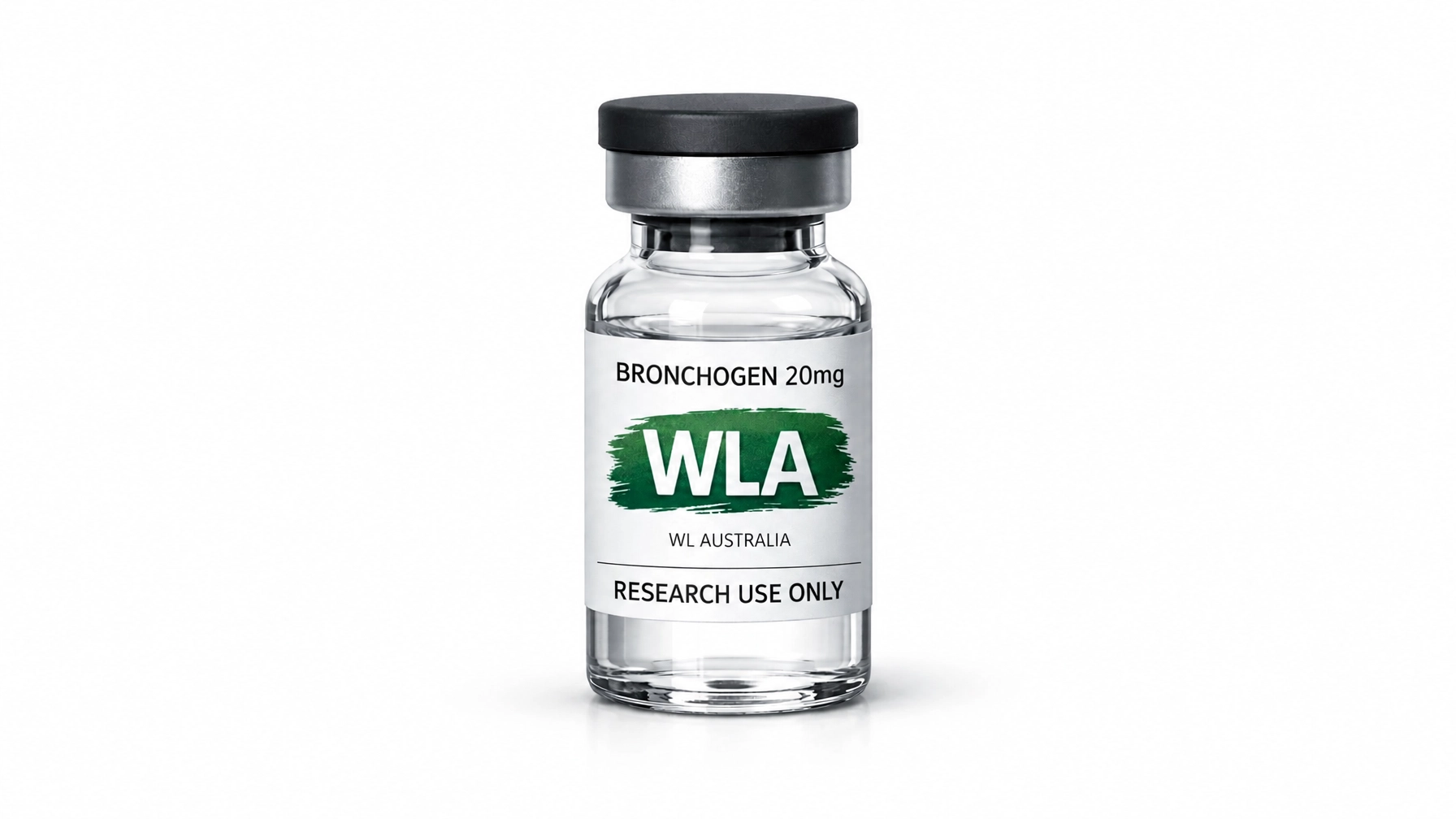
Bronchogen is a synthetic Khavinson-style bioregulator peptide being studied for its proposed relationship with bronchial epithelium and lung tissue. The product page describes Bronchogen 20mg as a research chemical only: not for human use.
This distinction matters. Bronchogen is not a TGA-approved medicine, asthma treatment, chronic obstructive pulmonary disease (COPD) treatment or general consumer supplement. Its potential respiratory roles remain experimental.
What Is Bronchogen?
The problem: respiratory biology is difficult to understand
The lungs are more than inflatable air bags. They contain branching airways lined with specialised epithelial cells. These cells form a protective barrier between your internal tissues and the outside world.
Think of the bronchial epithelium as the walls, doors and security system of a building:
- The epithelial barrier forms the protective outer wall.
- Mucus traps dust, particles and microorganisms.
- Cilia, microscopic hair-like structures, move mucus towards the throat.
- Local immune factors help identify and respond to unwanted material.
- Deeper lung structures exchange oxygen and carbon dioxide.
When this system becomes irritated, the “security and cleaning team” can struggle. Mucus may become harder to move, inflammation may increase, and the airway lining may be placed under greater stress.
The research concept: a targeted peptide signal
Bronchogen is commonly described as a synthetic tetrapeptide, meaning it contains four amino acids. The product information identifies the sequence as AEDL: alanine, glutamic acid, aspartic acid and leucine.
In bioregulator research, short peptide sequences are explored as possible biological signals. The analogy is a software instruction sent to a specific department rather than a fuel that powers the entire building. Researchers investigate whether the peptide can influence cellular activity connected with tissue maintenance, repair and normal function.
That is the theory. It is not proof of a clinical effect.
Learn more about Bronchogen 20mg on the product page.
Why the Bronchial Epithelium Matters

The problem: the airway lining faces constant exposure
Every breath brings your respiratory system into contact with the environment. In Australia, that may include urban particulate pollution, dust, seasonal allergens, workplace irritants and bushfire smoke.
The airway lining must continually manage this exposure while maintaining a controlled amount of mucus and inflammation. If the balance is disrupted, the result may be coughing, irritation or slower clearance of inhaled particles.
The solution being explored: support the airway’s maintenance system
Preclinical Bronchogen research has focused on the bronchial epithelium and related lung-tissue changes. Researchers have examined whether the peptide may influence:
- Epithelial integrity: the strength and organisation of the airway lining.
- Cell turnover: the normal replacement of ageing or damaged cells.
- Ciliary function: the movement of mucus and trapped particles.
- Mucus-producing cells: cells that help create the airway’s protective coating.
- Inflammatory signalling: chemical messages involved in immune activation.
Picture an airport conveyor belt. Mucus is the belt, trapped particles are the luggage, and cilia are the tiny motors moving everything towards the exit. If the motors slow down or the belt becomes overloaded, clearance becomes less efficient. Bronchogen is being investigated as a possible biological signal involved in maintaining that system.
Short summary: Bronchogen research is centred on airway structure and function: not instant relief and not a replacement for respiratory medicine.
Bronchogen and Local Immune Defence
The problem: the airways need protection without excessive inflammation
Your respiratory tract has its own local immune environment. One important component is secretory immunoglobulin A (sIgA). Immunoglobulins are antibodies; secretory immunoglobulin A is found on mucosal surfaces, including the airways, where it helps interact with inhaled material.
You can think of sIgA as a security badge system at the entrance to a building. It helps the body recognise what belongs and what may require attention.
However, immune defence is not simply about “more inflammation.” A healthy airway requires balance. Too little protection may leave the barrier vulnerable, while excessive inflammatory signalling can contribute to tissue irritation.
The research solution: investigate immune balance at the airway surface
A PubMed-indexed rat study examined Bronchogen in a model of obstructive lung pathology. The researchers reported changes involving:
- Bronchial epithelial remodelling
- Ciliated-cell restoration
- Secretory IgA production
- Inflammatory cell composition
- Pro-inflammatory cytokine profiles
These findings are scientifically interesting, but the study involved rats, not people. An animal model can help researchers identify a possible mechanism, like a wind-tunnel test can help engineers understand an aircraft. It cannot confirm how the aircraft will perform in every real-world situation.
You can read the study here: Bronchogen and bronchial epithelium research on PubMed.
The evidence boundary is clear: current findings do not establish that Bronchogen prevents respiratory infections, treats asthma or COPD, improves human lung function, or strengthens human immunity.
What Makes Bronchogen Different From a Standard Supplement?
Bronchogen belongs to the research-peptide and bioregulator category rather than the everyday supplement category.
| Feature | Bronchogen |
|---|---|
| Product type | Synthetic tetrapeptide research compound |
| Commonly described sequence | AEDL |
| Research focus | Bronchial epithelium and lung-tissue biology |
| Evidence stage | Primarily preclinical |
| Human therapeutic approval | Not TGA-approved |
| Product status on wlaustralia.com.au | Research use only; not for human use |
| Dosing guidance | No human-use dosing instructions should be inferred |
| Role in respiratory care | Experimental research interest, not standard treatment |
This is why you should assess Bronchogen differently from a vitamin, mineral or registered complementary medicine. A supplement is commonly purchased for personal use within its approved category. A research compound is intended for controlled laboratory investigation and must be handled according to applicable laws, safety systems and institutional requirements.
Explore the wider wlaustralia bioregulator collection to understand how products are categorised.
[Video Placeholder 1: Expert explainer on the bronchial epithelium, cilia and airway barrier function]
Bronchogen in the Australian Respiratory Context
The problem: environmental exposure can increase respiratory stress
Australia’s respiratory environment can change quickly. Sydney and Melbourne may experience urban pollution and pollen exposure, while regional communities may face dust and smoke from landscape fires. During bushfire events, fine particles known as PM2.5: particulate matter measuring 2.5 micrometres or less: can travel deep into the respiratory system.
This makes practical respiratory maintenance important regardless of interest in experimental compounds.
The solution: start with proven foundations
Before considering any experimental research direction, focus on the basics:
- Check local air-quality and smoke information during pollution or bushfire events.
- Reduce outdoor exertion when air quality is poor.
- Avoid smoking and second-hand smoke.
- Follow your prescribed asthma or COPD action plan.
- Keep medically prescribed inhalers and other treatments available.
- Maintain hydration, sleep and regular physical activity when appropriate.
- Discuss persistent respiratory symptoms with a qualified healthcare professional.
The Lung Foundation Australia guidance on air quality and lung health provides practical information for managing exposure.
If you experience severe breathlessness, chest pain, blue lips, confusion or rapidly worsening symptoms, seek urgent medical help. In Australia, call 000 in an emergency.
Safety, Legal Compliance and Medical Oversight

The problem: online descriptions can sound more certain than the evidence
Research peptides are often discussed using confident language such as “repairs,” “rebuilds” or “boosts immunity.” These phrases can make experimental findings sound like established treatments.
That leap is unsafe.
The responsible solution: keep research and treatment separate
Bronchogen should not be used to self-treat:
- Asthma
- COPD
- Bronchitis
- Pneumonia
- Long COVID
- Emphysema
- Unexplained shortness of breath
- Recurrent respiratory infections
Do not infer a dose, route of administration or reconstitution method from the vial size or from online discussion. Do not use it in place of prescribed treatment. Human use of a research-only compound raises questions about product quality, sterility, interactions, adverse effects and long-term safety.
For Australian regulatory context, review the Therapeutic Goods Administration guidance on listed and registered complementary medicines. Bronchogen’s product listing also states that it is not an approved medication and is not for human use.
[Video Placeholder 2: Research-use-only handling, documentation and respiratory-health safety overview]
The Bottom Line
Bronchogen is a Khavinson-style synthetic bioregulator peptide being studied in relation to bronchial epithelial biology, lung-tissue maintenance and local airway immune markers. Preclinical research has produced signals worth investigating, including findings involving ciliated cells, secretory immunoglobulin A and inflammatory profiles in animal models.
But the human evidence is not established.
Use the information as a research overview, not as a treatment recommendation. Build respiratory resilience through proven foundations, respect Australian regulatory requirements, and seek medical advice for any ongoing or worsening symptoms.
Research demands curiosity. Responsible research demands limits.
For product specifications and current availability, visit the Bronchogen 20mg product page.

 Immune Support and Life Extension
 Shop Bioregulators & Research Chemicals for 2026 Scientific Labs
 Brain
Brain Buy Hair & Skin Care Peptides Australia – Top Quality & Best Prices
 Discover WLAustralia Peptides for Anxiety Relief & Longevity