
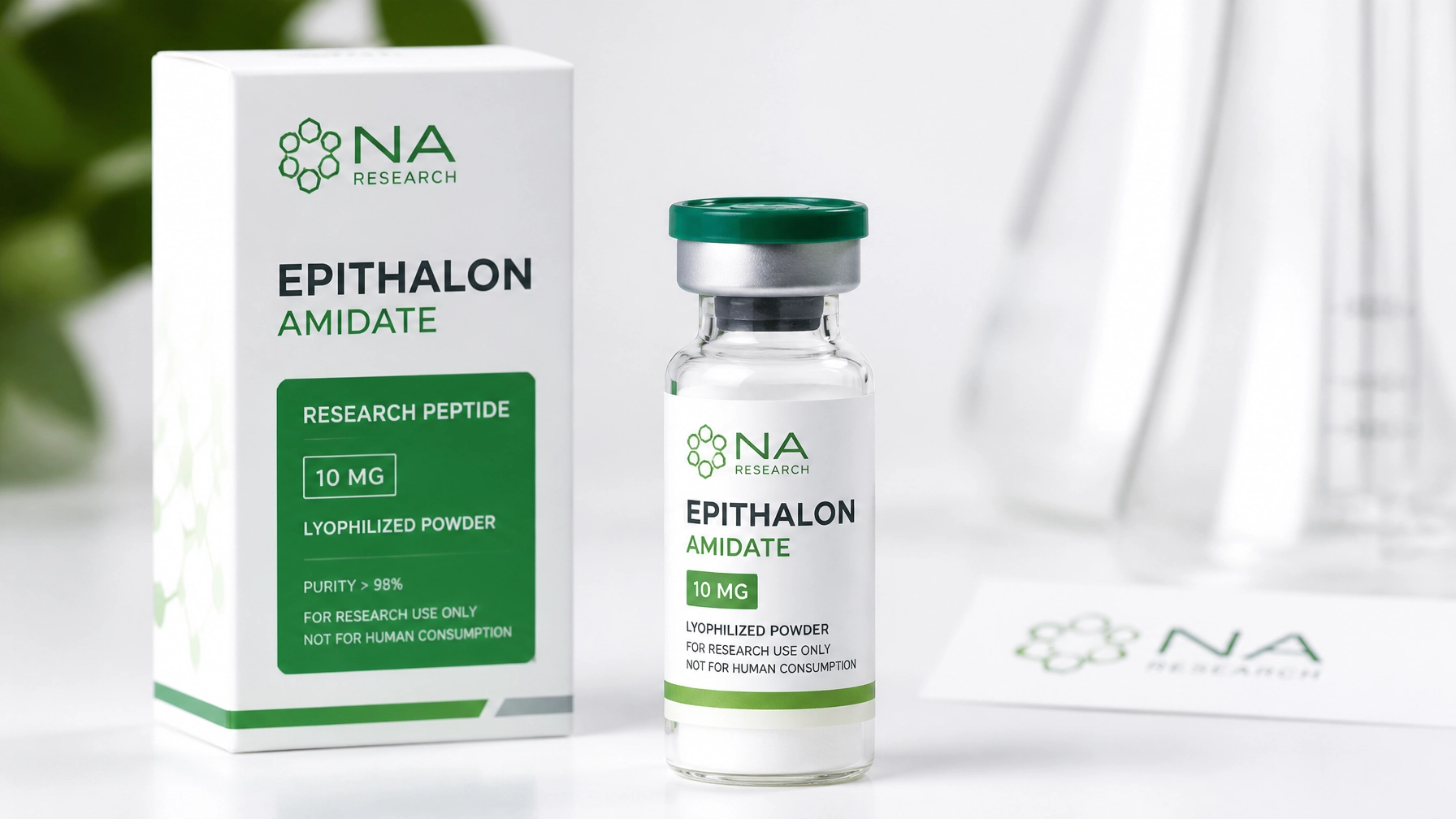
NA Epithalon Amidate: The Enhanced Bioavailability Peptide for Longevity Research

You are standing at the frontier of cellular science, where every microscopic repair mechanism dictates how gracefully and resiliently your biology withstands the relentless passage of time. If you have spent any time exploring advanced longevity research, you have likely encountered Epithalon: the legendary tetrapeptide studied extensively for its impact on cellular lifespan and pineal gland function. Yet, traditional peptides often face a formidable roadblock: metabolic breakdown before they ever reach their cellular targets.
To overcome this bottleneck, peptide scientists engineered a breakthrough variant: N-Acetyl Epithalon Amidate (NA Epithalon Amidate). By introducing specific chemical modifications, this advanced compound offers heightened metabolic stability and superior cellular penetration.
As you navigate the complex world of modern biochemistry, you will learn how this modified peptide operates, why bioavailability is the ultimate gatekeeper of efficacy, and how researchers approach its study under strict regulatory frameworks. For a comprehensive overview of available research tools, explore our shop or check our legal guidelines to ensure absolute compliance in your laboratory.
1. The Bioavailability Bottleneck: Why Standard Peptides Fall Short
The Problem: Enzymatic Degradation in Biological Systems
Imagine trying to deliver a vital blueprint across a bustling construction site where aggressive demolition crews: known in biology as proteolytic enzymes: tear apart every piece of paper before it reaches the master architect. When standard peptides are introduced into biological environments, endogenous peptidases often dismantle their amino acid chains within minutes. Unmodified peptides suffer from extremely low oral bioavailability: often dropping below 1%: forcing researchers to rely heavily on precise delivery routes and structural hardening.
The Solution: Molecular Armor Through Chemical Engineering
To solve this frustration, scientists apply targeted chemical modifications. In the case of NA Epithalon Amidate, two distinct structural alterations are performed:
- N-acetylation (adding an acetyl group at the N-terminus).
- Amidation (modifying the C-terminus).
Think of these modifications as industrial-grade shrink-wrap around a delicate package. They shield the peptide backbone from enzymatic scissors, drastically extending its half-life and ensuring greater systemic availability per microgram. Through this structural optimization, the peptide maintains its integrity longer, allowing for deeper cellular penetration and more consistent biological synergy.

2. Decoding NA Epithalon Amidate: Structure vs. Standard Epithalon
The Problem: Navigating Variant Confusion in Peptide Research
When reviewing literature, researchers often struggle to distinguish between standard Epithalon (a synthetic tetrapeptide composed of Alanine, Glutamic Acid, Aspartic Acid, and Glycine: Ala-Glu-Asp-Gly) and its N-acetylated, amidated counterpart. Without clear definitions, it is easy to misjudge dosage equivalencies or assume entirely different mechanisms of action.
The Solution: A Comparative Breakdown
Both compounds share identical core biological targets: specifically, telomerase upregulation and pineal gland modulation. However, their pharmacokinetic profiles differ significantly.
| Feature | Standard Epithalon | NA Epithalon Amidate |
|---|---|---|
| Structure | Unmodified tetrapeptide (Ala-Glu-Asp-Gly) | N-acetylated and C-amidated tetrapeptide |
| Enzymatic Resistance | Moderate; susceptible to rapid cleavage | High; protected terminals resist peptidases |
| Bioavailability | Lower systemic retention without specialized delivery | Enhanced metabolic stability and systemic retention |
| Research Focus | Foundational telomere elongation & pineal studies | Advanced pharmacokinetic efficiency & targeted longevity |
Focus on these structural nuances when designing your protocols. To calculate accurate concentrations for your laboratory work, utilize our dedicated reconstitution calculator.
3. Cellular Architecture: Telomeres, Telomerase, and the Zippers of Aging
The Problem: Cellular Senescence and Genomic Countdown
Picture your chromosomes as shoelaces, and the protective plastic tips at the end: known as telomeres: as the aglets that prevent the laces from fraying. Every time a somatic cell divides, these telomeres shorten slightly. Eventually, when they become critically short, the cell enters senescence (stasis) or apoptosis (programmed cell death). This biological countdown is a primary driver of tissue aging.
The Solution: Activating the Cellular Maintenance Crew
NA Epithalon Amidate is studied extensively for its ability to support telomerase: the specialized enzyme responsible for maintaining telomere length. By acting like a specialized molecular zipper mechanic, telomerase rebuilds and preserves the ends of chromosomes, thereby extending the replicative lifespan of human somatic cells in vitro.
[Cellular Division] ---> [Telomere Shortening] ---> [Senescence Triggered]
                                                            |
                                               (NA Epithalon Amidate Intervention)
                                                            v
                                            [Telomerase Activation & Maintenance]
You must recognize that telomerase activation is a sophisticated biological lever. While it promotes cellular longevity and robust tissue recovery, researchers must balance this against strict experimental controls to ensure safety and precision.

4. The Master Clock: Pineal Gland Regulation and Circadian Optimization
The Problem: Circadian Disruption and Melatonin Decline
As the human organism ages, the pineal gland: often referred to as the master pacemaker of the endocrine system: experiences calcification and a progressive decline in melatonin synthesis. This hormonal deficit wreaks havoc on sleep architecture, immune function, and systemic recovery, leaving you feeling chronically fatigued and out of sync.
The Solution: Restoring Pineal Homeostasis
NA Epithalon Amidate mirrors the pineal-regulating properties of its parent compound, epithalamin. By interacting directly with neuroendocrine pathways, it supports the restoration of normal circadian melatonin rhythms.
- Phase 1: Signal Reception – The peptide binds to target receptors within pineal tissue.
- Phase 2: Enzymatic Support – Stimulates optimal secretory function in aging neuroendocrine cells.
- Phase 3: Circadian Harmonization – Enhances restorative sleep patterns and systemic biological rhythm.
Consider this pineal support as tuning an orchestra's master instrument. When the master clock is calibrated, every downstream physiological process achieves greater harmony and optimization.
5. Practical Application, Dosage Protocols, and Laboratory Safety
The Problem: Protocol Inconsistencies and Handling Errors
Even the most advanced peptide will yield inconsistent results if handled improperly during reconstitution, storage, or administration planning. Researchers often stumble when converting molar concentrations or ignoring cold-chain storage requirements.
The Solution: Structured Protocol Management
To ensure absolute precision in your studies, adhere to structured workflows:
- Reconstitution: Use bacteriostatic water and gentle swirling (never violent shaking) to protect the delicate peptide bonds.
- Dosage Planning: Consult verified scientific literature and map out your timeline using our research dosage worksheet.
- Safety Compliance: Review our comprehensive dosage guide to maintain rigorous laboratory standards.
[VIDEO_PLACEHOLDER: Watch our expert guide on safe peptide reconstitution and handling techniques for modern laboratories.]

Regulatory and Ethical Oversight
Always remember that research peptides distributed by WL Australia are strictly intended for laboratory, in vitro, and scientific research use only. They are not evaluated by therapeutic goods administrations for human consumption. Maintain strict legal compliance and prioritize ethical research oversight in every study you undertake.
6. Conclusion: Taking Control of Biological Horizons
You have now journeyed through the intricate biochemistry of NA Epithalon Amidate: from the foundational barriers of enzymatic degradation to the sophisticated realms of telomerase activation and pineal gland harmonization. By leveraging N-acetylation and amidation, this advanced peptide represents a monumental leap in bioavailability and metabolic stability.
[VIDEO_PLACEHOLDER: Explore a detailed visual summary of telomere maintenance and pineal regulation mechanisms.]

Take control of your research potential today. Equip your laboratory with the highest-grade compounds, utilize our precision tools, and continue pushing the boundaries of longevity science with absolute confidence and professional rigor.


 Immune Support and Life Extension
 Shop Bioregulators & Research Chemicals for 2026 Scientific Labs
 Brain
Brain Buy Hair & Skin Care Peptides Australia – Top Quality & Best Prices
 Discover WLAustralia Peptides for Anxiety Relief & Longevity