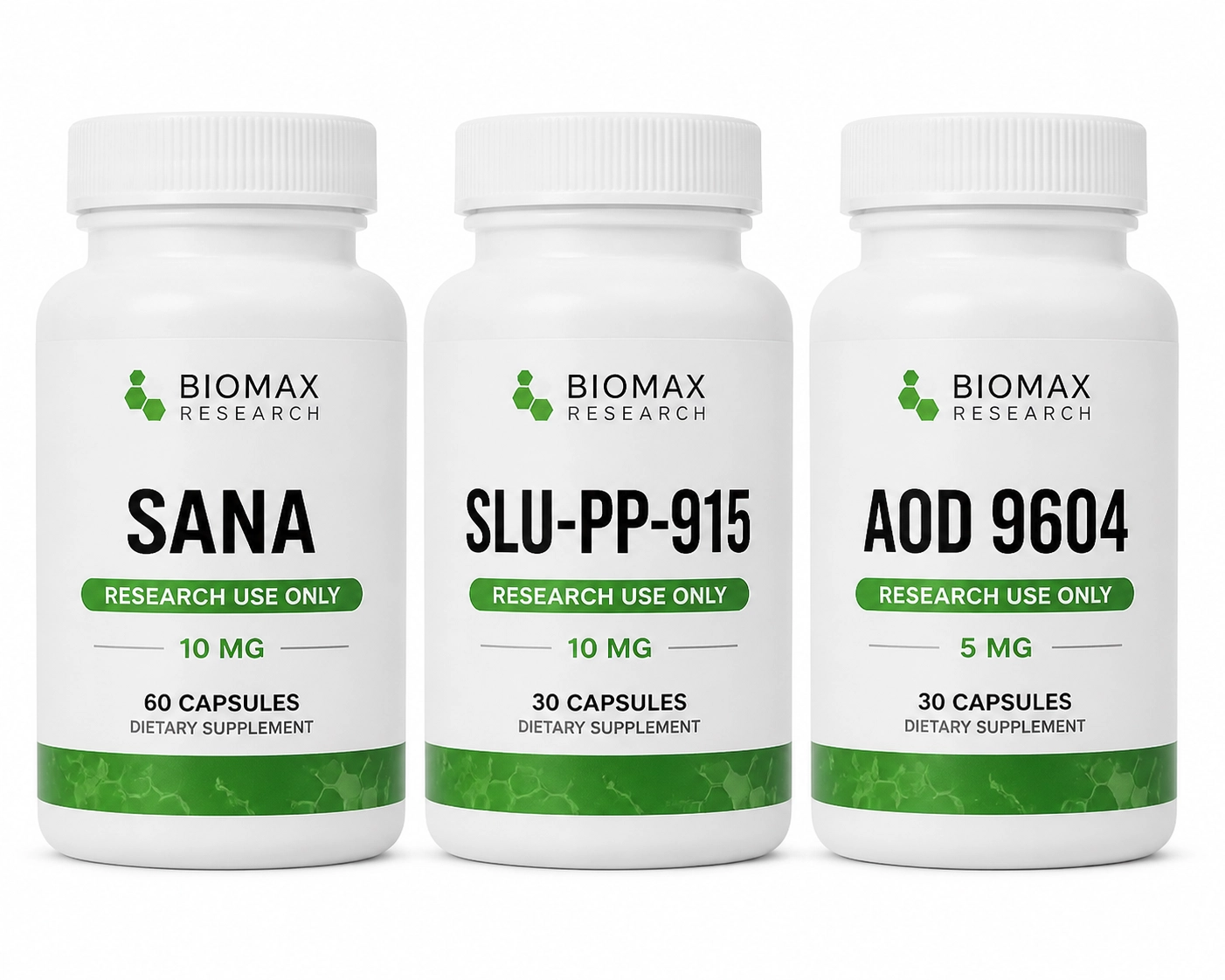
The Triple Threat Metabolic Stack: SANA, SLU-PP-915 & AOD 9604 for Total Fat Loss

You have spent months dialing in your macros, crushing your workouts, and tracking every calorie, yet that stubborn pocket of fat refuses to budge. The frustration of hitting a hard metabolic plateau is something every biohacker and fitness enthusiast knows all too well. When your body's internal thermostat locks into survival mode, standard calorie restriction feels like trying to bail out a sinking ship with a teaspoon.
To break through this barrier, you must move beyond basic dieting and look toward advanced biological optimization. Enter the conceptual "triple threat" metabolic stack: SANA (5-(2-nitroethenyl)salicylic acid), SLU-PP-915, and AOD 9604. Think of this combination not as a magic pill, but as tuning a high-performance race car where three distinct mechanics work on three separate engine components simultaneously.
In this comprehensive guide, you will learn how each compound targets a unique physiological pathway: creatine thermogenesis, mitochondrial uncoupling, and growth hormone-mediated lipolysis: and why understanding their synergy and safety profile is vital before making any decisions. For a deeper look at research protocols, visit our research dosage worksheet or reach out via our contact us page.
1. SANA (5-(2-nitroethenyl)salicylic acid): The Creatine-Thermogenesis Engine

The Problem: Sluggish Adipose Energy Expenditure
When you restrict calories, your fat tissue (adipose tissue) fights back by conserving energy, slowing down cellular respiration, and reducing heat production. Your cells act like a miserly bank vault, locking away triglycerides and refusing to burn them as heat.
The Solution: First-in-Class Adipose Activation
SANA (5-(2-nitroethenyl)salicylic acid) is a groundbreaking nitroalkene derivative that acts as a first-in-class activator of creatine-dependent thermogenesis in adipose tissue. Imagine a construction crew suddenly lighting a massive bonfire inside your fat cells, turning stored fat directly into body heat without requiring you to shiver or exercise.
- Mechanism: SANA binds to creatine kinases (CKMT1/2), stimulating mitochondrial respiration and burning energy through a creatine-cycling loop.
- UCP1 Independence: Unlike traditional uncouplers, SANA operates independently of Uncoupling Protein 1 (UCP1), making it effective even in white adipose tissue.
- Metabolic Reset: Animal models and early human Phase 1 data show impressive improvements in insulin sensitivity, lipid profiles, and body weight reduction within short exposure windows.
Focus on SANA: By targeting creatine cycling, you unlock a novel channel of energy expenditure that bypasses standard hormonal bottlenecks.
2. SLU-PP-915: The Mitochondrial Uncoupling Accelerator

The Problem: Cellular Energy Stagnation
Even when your fat cells are mobilized, your cellular power plants (mitochondria) can become bogged down, producing ATP (adenosine triphosphate: the primary energy currency of the cell) with maximum efficiency. High efficiency sounds good on paper, but in fat loss, maximum efficiency means your body refuses to waste any excess fuel as heat.
The Solution: Direct Mitochondrial Protonophore Action
SLU-PP-915 is a research-only small molecule designed as a mitochondrial protonophore/uncoupler. Imagine slightly opening the safety valve on a high-pressure steam boiler. SLU-PP-915 gently dissipates the mitochondrial proton gradient, forcing your cells to burn significantly more substrate (fatty acids and glucose) just to maintain baseline cellular energy.
- Systemic Energy Output: While SANA focuses on creatine-dependent pathways in fat tissue, SLU-PP-915 drives whole-body resting energy expenditure.
- Substrate Oxidation: This uncoupling action forces your metabolism to aggressively oxidize circulating lipids.
[Video Placeholder: Watch our expert breakdown of mitochondrial protonophores and metabolic uncoupling dynamics.]
Action Step: Always review regulatory compliance and supplier purity certificates on our legal page before handling experimental research compounds.
3. AOD 9604: The Growth Hormone-Mediated Lipolytic Specialist

The Problem: Stubborn Fat Storage (Lipogenesis)
You can increase thermogenesis all day long, but if your body's default hormonal signaling actively promotes fat storage (lipogenesis) over fat breakdown (lipolysis), your net progress will stall.
The Solution: Precision Peptide Mobilization
AOD 9604 is a synthetic peptide fragment representing amino acids 176–191 of human growth hormone (GH 176–191). Think of AOD 9604 as a master locksmith equipped with a specialized key that unlocks fat cell membranes. It stimulates lipolysis and inhibits lipogenesis without triggering the unwanted IGF-1 (insulin-like growth factor 1) spikes or blood sugar fluctuations associated with full-length growth hormone.
- Targeted Mobilization: AOD 9604 frees up stored triglycerides so they can be released into the bloodstream.
- The Synergy Effect: Once AOD 9604 mobilizes those fatty acids, compounds like SANA and SLU-PP-915 provide the furnace needed to oxidize them completely.
4. The Synergy Showdown: Comparing the Triple Threat Pathways

To truly master biological optimization, you must understand how these three agents complement one another. Let us break down their mechanisms side-by-side:
| Compound | Primary Pathway | Cellular Mechanism | Main Physiological Result | Clinical / Research Status |
|---|---|---|---|---|
| SANA | Adipose Thermogenesis | Binds creatine kinases, drives creatine-cycling | Increased heat generation & weight loss independent of UCP1 | Phase 1 human trials completed; research use only |
| SLU-PP-915 | Mitochondrial Uncoupling | Protonophore action across inner mitochondrial membrane | Elevated resting energy expenditure & substrate oxidation | Preclinical animal models; experimental research compound |
| AOD 9604 | GH-Mediated Lipolysis | Mimics GH region 176–191 to stimulate fat release | Enhanced lipolysis without IGF-1 elevation or blood sugar impact | Investigated in human trials; restricted in athletic competition |
[Video Placeholder: Detailed comparison walkthrough of multi-pathway metabolic stacks and physiological safety margins.]
Pro Tip: To explore our broader company mission and quality standards, visit our about us page.
5. Navigating Safety, Compliance & Medical Oversight in Australia
The Problem: The Risks of Unregulated Stacking
While the theoretical synergy of combining SANA, SLU-PP-915, and AOD 9604 is fascinating for researchers, stacking experimental agents multiplies potential risks. Unregulated thermogenic stacking can lead to:
- Thermoregulatory Strain: Overheating or subclinical chronic hyperthermia from stacked energy dissipation.
- Cardiovascular Stress: Tachycardia and elevated heart rate resulting from excessive metabolic demand.
- Hepatic & Mitochondrial Fatigue: Overworking cellular machinery without adequate recovery.
The Solution: Strict Medical Oversight and Regional Compliance
As an Australian researcher or consumer, you must prioritize safety, legal compliance, and professional guidance above all else.
- Consult Healthcare Professionals: Never self-administer experimental stacks without direct medical supervision.
- Respect Local Regulations: Compounds like SANA and SLU-PP-915 are distributed strictly for laboratory and in vitro research purposes. AOD 9604 is restricted under WADA guidelines for competitive athletes.
- Prioritize Baseline Health: Focus on sleep, foundational nutrition, and hormone balance before considering advanced metabolic modulators.
Take Control: True biological optimization is a marathon, not a sprint. Protect your health by relying on transparent science, rigorous testing, and clinical oversight. Ready to learn more? Connect with our team via our contact us page.

 Immune Support and Life Extension
 Shop Bioregulators & Research Chemicals for 2026 Scientific Labs
 Brain
Brain Buy Hair & Skin Care Peptides Australia – Top Quality & Best Prices
 Discover WLAustralia Peptides for Anxiety Relief & Longevity