9-Me-BC Capsules: The Dopamine-Boosting Nootropic for Cognitive Health and Neuroprotection

If you are researching advanced compounds for dopamine biology, memory, and neuronal resilience, 9-Me-BC is a compound worth understanding carefully. Also called 9-methyl-beta-carboline, it is a synthetic beta-carboline investigated for its effects on dopaminergic neurons, cognitive function, and neuroprotection.
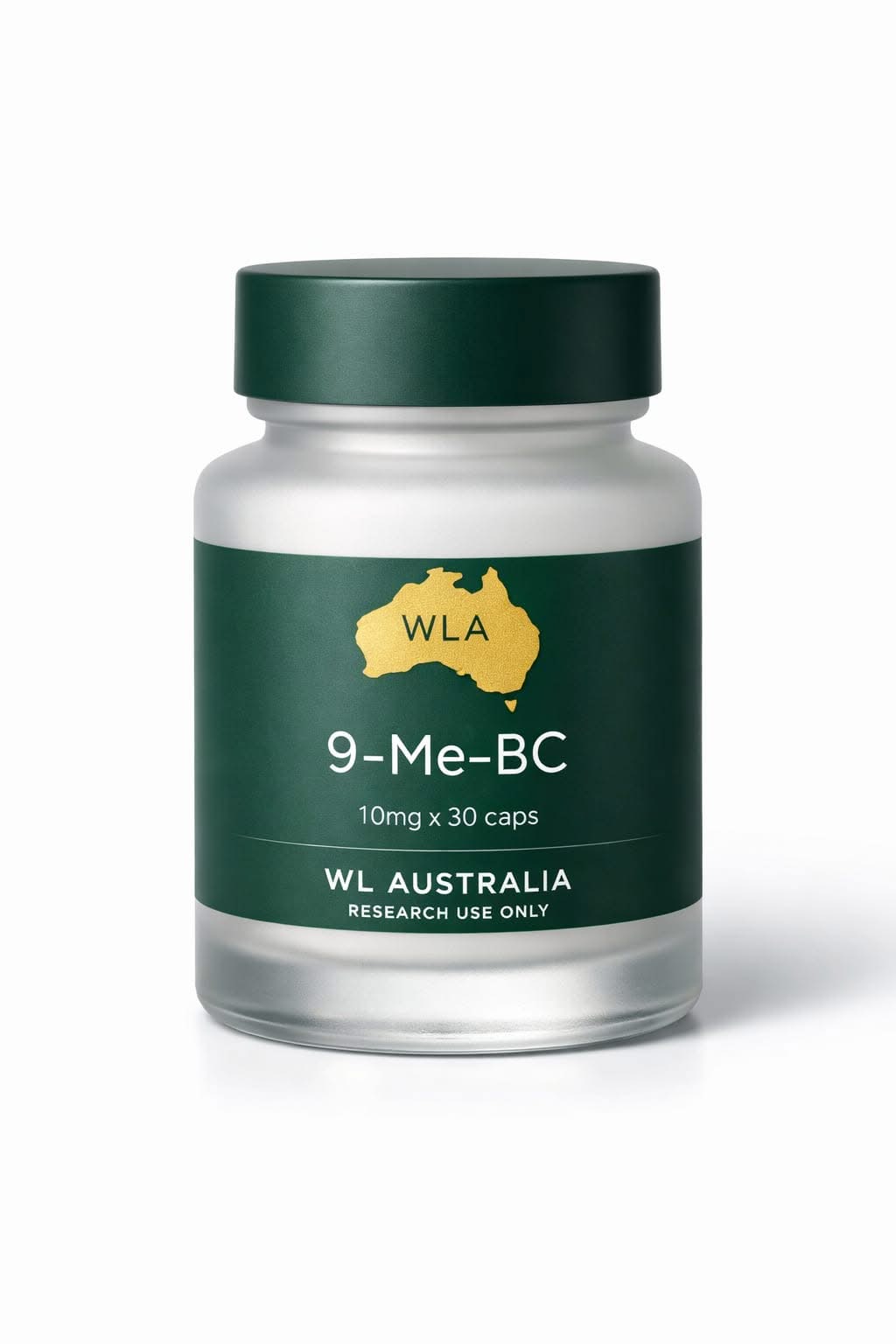
However, the most important point comes first: 9-Me-BC is an experimental research chemical. It is not approved for human use, and there are no established human doses or reliable long-term safety data. WL Australia lists its 9-Me-BC 10mg/cap, 30caps/bottle product for research use only.
This article explains the science without turning preclinical findings into promises. Think of it as a map of the research landscape: not a treatment plan.
Important: This product is labelled research use only: not for human use. Do not ingest it or use it as a supplement. Any work involving experimental chemicals should be performed by appropriately qualified professionals under relevant institutional, legal, and safety requirements.
What is 9-Me-BC?
The problem: dopamine research is often reduced to “more is better”
Dopamine is commonly described as a motivation or reward chemical. That is an oversimplification. It is a neurotransmitter involved in movement, attention, learning, motivation, reward prediction, and several other functions.
A better analogy is to think of dopamine as part of a traffic-control system. It helps direct signals to the right destination at the right time. Increasing activity without understanding the system can create congestion rather than better flow.
The research solution: study the machinery behind dopamine
9-Me-BC is being studied because it may influence several parts of the dopaminergic system, including:
- Dopamine synthesis pathways
- Dopaminergic neuron development and survival
- Monoamine oxidase activity
- Neuroinflammatory processes
- Hippocampal learning and synaptic structure
The current evidence comes mainly from cell cultures and animal studies. Human results cannot be assumed.
How 9-Me-BC may affect dopamine synthesis
The problem: dopamine production depends on a biological “factory”
Your brain does not produce dopamine by simply switching on a tap. It uses a sequence of enzymes and cellular processes. One important enzyme is tyrosine hydroxylase, often abbreviated as TH.
TH acts like the first major machine on a production line. It helps convert tyrosine into a precursor that can eventually become dopamine. If the machinery is damaged or poorly regulated, the output of the whole line may change.
The research solution: investigate enzyme and neuron markers
Preclinical research has reported that 9-Me-BC can increase markers associated with dopaminergic neurons, including TH and other genes involved in dopamine-cell identity and function.
Researchers have also studied changes involving:
- Dopamine transporter, which helps regulate dopamine signalling
- Aldehyde dehydrogenase 1A1, a marker associated with dopaminergic neuron biology
- Nurr1 and Pitx3, transcription factors involved in dopaminergic neuron development and maintenance
This does not prove that 9-Me-BC increases dopamine in humans. It shows that the compound can influence dopamine-related biology under experimental conditions.
Short version: 9-Me-BC is being studied as a potential dopamine-system modulator, not as a proven human dopamine booster.

MAO-B inhibition: what does it mean?
The problem: monoamine breakdown can change neurotransmitter levels
Monoamine oxidase, or MAO, is a family of enzymes that helps break down neurotransmitters such as dopamine, serotonin, and noradrenaline.
You can picture MAO as part of the brain’s recycling and clearance system. It prevents signalling chemicals from remaining active indefinitely. If MAO activity is inhibited, some neurotransmitters may remain available for longer.
9-Me-BC has been investigated for inhibition of both:
- MAO-A, which is strongly involved in the metabolism of serotonin and noradrenaline, as well as dopamine
- MAO-B, which is particularly associated with dopamine metabolism in certain brain regions
Although 9-Me-BC is often discussed as a selective MAO-B-related compound, research summaries report activity against both isoforms, with greater apparent potency toward MAO-A in some laboratory tests. The relevance of these test-tube concentrations to humans is unknown.
The research solution: separate mechanism from outcome
MAO inhibition may help explain why researchers observe changes in dopamine-related signalling. It may also contribute to the compound’s reported effects in cellular and animal models.
But this mechanism creates a serious safety issue. If meaningful MAO-A inhibition occurs in a person, interactions with prescription medicines, recreational drugs, stimulants, and other substances could become clinically important.
Do not combine experimental 9-Me-BC with:
- Antidepressants, including selective serotonin reuptake inhibitors (SSRIs) and serotonin-noradrenaline reuptake inhibitors (SNRIs)
- Monoamine oxidase inhibitor medicines
- Stimulants or sympathomimetic medicines
- Serotonergic medicines or supplements
- Certain opioid pain medicines
- Other experimental dopaminergic or nootropic compounds
A clinician or pharmacist should review any potential interaction. Do not attempt to manage MAO-related risks through internet dosing advice.
Neuroprotection and dopaminergic neuron research
The problem: neurons operate under constant metabolic pressure
Neurons are like high-performance electrical infrastructure. They need continuous energy, stable membranes, accurate signalling, and protection from oxidative stress.
Dopaminergic neurons can be particularly vulnerable because dopamine metabolism may generate oxidative by-products. In addition, the mitochondria: the cell’s energy plants: must work continuously to support long axons and complex connections.
The research solution: examine survival, energy, and regeneration markers
In cell-based experiments, 9-Me-BC has been associated with several findings of interest, including:
- Reduced markers of cell damage
- Lower activity of some apoptosis-related pathways
- Increased cellular ATP in certain experimental settings
- Greater numbers of dopaminergic neurons or dopaminergic markers
- Changes in neurotrophic and differentiation factors
Animal studies have also explored whether 9-Me-BC can protect dopaminergic pathways in models of Parkinsonian injury. Some studies reported improved dopamine content and motor performance in rodents.
These findings are scientifically interesting, but they are not evidence that 9-Me-BC prevents, treats, or reverses Parkinson’s disease or any other human neurological condition.
The key principle is evidence before enthusiasm. A promising cell or animal result is the beginning of translational research: not the end.
Cognitive enhancement and memory research
The problem: cognitive performance depends on more than stimulation
Focus is not simply a matter of pushing the brain harder. Learning depends on attention, memory formation, synaptic plasticity, sleep, energy balance, and emotional state.
A useful analogy is a sports team. A louder coach does not automatically produce a better result. Training, recovery, coordination, and strategy all matter.
The research solution: study learning and neural structure together
A rat study indexed by PubMed examined 9-Me-BC in a spatial learning task. After 10 days: but not 5 days: of treatment, the researchers reported:
- Improved performance in a radial-maze task
- Higher dopamine levels in the hippocampal formation
- Longer and more complex dendritic trees
- Increased spine numbers on dentate gyrus granule neurons
Dendrites are branching structures that receive signals from other neurons. Synaptic spines are small protrusions involved in communication between neurons. You can think of them as branches and connection points in the brain’s internal wiring.
The results suggest that 9-Me-BC may influence hippocampus-dependent learning in rats. They do not establish a reliable cognitive benefit in humans.
| Research area | What has been observed | What remains unknown |
|---|---|---|
| Dopamine synthesis | Changes in TH and dopaminergic markers in preclinical models | Whether human dopamine production changes |
| MAO activity | Inhibition of MAO-A and MAO-B in laboratory research | Human brain concentrations and interaction risk |
| Neuroprotection | Reduced cell-damage markers in some models | Long-term human neurological safety |
| Memory | Improved spatial learning in rats after repeated exposure | Whether people experience better memory |
| Neuroregeneration | Changes in neuronal structure and growth markers | Whether these changes translate to meaningful human outcomes |
Understanding the WL Australia product
The WL Australia 9-Me-BC product page lists:
- 9-Me-BC: 10mg per capsule
- 30 capsules per bottle
- Research chemical only
- Not for human use
The capsule format provides a clearly identified research presentation, but it does not make the compound an approved supplement or medicine. In Australia, product classification, importation, possession, handling, and intended use may involve different requirements. Researchers should confirm applicable obligations with qualified regulatory, laboratory, and safety professionals.
🎥 Video placeholder: Insert a short educational video explaining what 9-Me-BC is, how preclinical evidence differs from human clinical evidence, and why “research use only” labelling matters.

Safety, storage, and responsible research practice
The problem: experimental compounds can look like ordinary supplements
A capsule bottle may resemble a standard wellness product, but appearance does not determine safety. With 9-Me-BC, major unknowns include human absorption, brain penetration, half-life, active metabolites, reproductive safety, organ toxicity, and long-term effects on dopamine regulation.
The research solution: use strict controls
If you are an appropriately qualified researcher, focus on:
- Keeping the product clearly labelled and inaccessible to unauthorised people
- Storing it according to the relevant laboratory safety documentation
- Maintaining batch, date, handling, and disposal records
- Avoiding food, drink, and personal supplement storage areas
- Using suitable personal protective equipment and contamination controls
- Following institutional approval and chemical-waste procedures
- Seeking medical advice immediately after accidental exposure
Do not use the product to self-treat low mood, fatigue, attention problems, memory loss, Parkinson’s disease, or any other condition. If you are experiencing symptoms, speak with a registered Australian health professional.
Safety is not an optional add-on. It is part of the protocol.
Final perspective
9-Me-BC is attracting research interest because it appears to work across several connected biological systems: dopamine synthesis, monoamine metabolism, neuronal survival, neurotrophic signalling, and hippocampal plasticity.
That combination makes it scientifically compelling. It does not make it clinically proven.
The most responsible way to view 9-Me-BC is as an experimental tool for qualified research into dopaminergic biology and cognitive mechanisms. For consumers seeking cognitive support, the safer foundation remains evidence-based healthcare, consistent sleep, physical activity, balanced nutrition, and professional assessment of persistent symptoms.
🎥 Video placeholder: Insert a safety-focused video covering MAO-related interaction risks, Australian research-chemical responsibilities, storage, and when to seek professional help.
For product specifications, see the 9-Me-BC 10mg/cap, 30caps/bottle product page. For broader product information, visit the WL Australia shop and review the terms and conditions.

 Immune Support and Life Extension
 Shop Bioregulators & Research Chemicals for 2026 Scientific Labs
 Brain
Brain Buy Hair & Skin Care Peptides Australia – Top Quality & Best Prices
 Discover WLAustralia Peptides for Anxiety Relief & Longevity