Adipotide: The Fat-Vascular Targeting Peptide for Research Into Adipose Reduction

Important: Adipotide is an experimental research compound. It is not an approved weight-loss medicine, supplement, or treatment for human use. This article is educational only and does not provide dosing, injection, reconstitution, or self-experimentation instructions.
When most people think about fat-loss research, they picture appetite control, increased energy expenditure, or changes in how the body processes glucose. Adipotide explores a different route.
Instead of acting mainly on the brain or digestive system, Adipotide has been studied as a fat-vascular targeting peptide. Its research concept is simple but powerful: target the blood vessels that supply white adipose tissue, then investigate what happens when that supply is disrupted.
Think of white fat as a large construction site. Adipocytes: the scientific name for fat cells: are the buildings, while the tiny blood vessels are the roads, power lines, and delivery routes. Adipotide research examines whether selectively damaging those delivery routes can cause the surrounding fat tissue to shrink.
The idea is innovative. The safety questions are equally important.
What is Adipotide?
Adipotide is an experimental fat-targeted proapoptotic peptide, sometimes described in scientific literature as a fat-targeted proapoptotic peptidomimetic. “Proapoptotic” means that it is designed to promote apoptosis, the controlled process of programmed cell death.
Unlike a typical appetite-focused compound, Adipotide is not primarily being studied as a hunger signal or metabolic stimulant. Its proposed action begins in the endothelium, the thin layer of cells lining blood vessels.
The research problem is targeting. Most substances that circulate through the body can reach many tissues. The proposed solution is a two-part molecular design:
- A homing domain helps direct the compound towards blood vessels associated with white adipose tissue.
- An effector domain is designed to damage the targeted endothelial cell after internalisation.
In simple terms, one part acts like a GPS system, while the second part carries the biological payload.
The key point: Adipotide research focuses on the infrastructure around fat tissue, not just the fat cell itself.

How does Adipotide target fat tissue blood supply?
The proposed targeting sequence is commonly identified as CKGGRAKDC. Research has associated this sequence with blood vessels supplying white adipose tissue, or WAT: the form of stored energy commonly referred to as body fat.
The sequence has been studied in relation to surface proteins including prohibitin and annexin A2. These proteins can act like molecular signposts on particular vascular cells. The targeting sequence is intended to recognise those signposts and bind to them.
Imagine entering a warehouse district where every building looks similar. A general delivery truck may stop at random doors. A GPS-guided vehicle, however, follows a specific address. Adipotide’s homing domain is designed to provide that address.
The proposed process is:
- Circulation: The peptide moves through the bloodstream in a research model.
- Recognition: The homing domain interacts with target markers associated with fat-feeding blood vessels.
- Internalisation: The targeted endothelial cell takes in the peptide-receptor complex.
- Mitochondrial disruption: The effector domain is designed to interfere with mitochondrial membranes.
- Apoptosis: The affected endothelial cell undergoes programmed cell death.
- Vascular regression: The local microvascular network may lose function or regress.
- Secondary adipose effects: Fat cells supplied by that network may experience reduced oxygen and nutrient delivery.
This is why Adipotide is described as fat-vascular targeting. The first target is the blood vessel. The potential reduction in adipose tissue is a downstream effect.
Think of it as shutting down a supply chain: not turning up a furnace.
What happens when the blood supply is disrupted?
Fat tissue is biologically active. It requires oxygen, glucose, fatty acids, hormones, and other nutrients. Its blood vessels also transport waste products away from the tissue.
When the local microvasculature is damaged, researchers may investigate several connected effects:
- Reduced oxygen delivery, sometimes described as local hypoxia.
- Reduced nutrient delivery to nearby adipocytes.
- Vascular remodelling or regression, meaning a change or loss in the small-vessel network.
- Stress signals within the fat tissue.
- Secondary cell death or tissue resorption in affected areas.
The term ischemia means inadequate blood flow to a tissue. It is a familiar concept in cardiovascular medicine, but in Adipotide research it is discussed in the context of targeted adipose-tissue vasculature.
The analogy is an irrigation system. If the main pipes supplying a field are closed, the crops do not immediately disappear. First, the water supply falls. Then the plants become stressed. Over time, the affected area may deteriorate.
That does not mean Adipotide “melts fat” in the everyday sense. It is not simply increasing calorie burning or dissolving adipose tissue. The research model investigates whether vascular disruption can lead to the loss and clearance of fat tissue.
What does the preclinical research show?
The most important evidence comes from animal studies, not human weight-loss trials.
In rodent models, earlier research reported substantial reductions in body weight after treatment with fat-targeted proapoptotic peptides. These studies supported the broader idea that adipose tissue mass can be influenced through its vascular network.
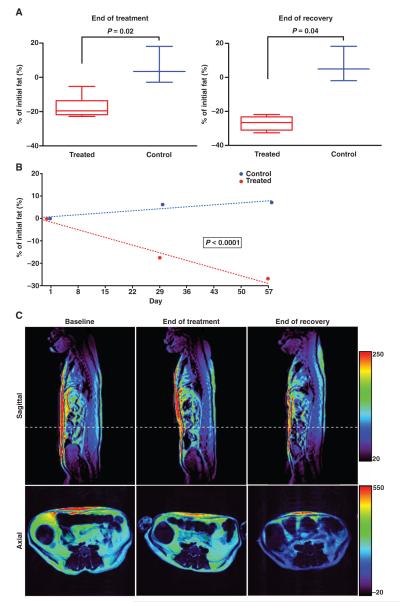
A later study in obese non-human primates investigated Adipotide in rhesus monkeys. The researchers reported:
- A reduction in body weight during the treatment period.
- A reduction in white adipose tissue measured with imaging.
- Changes in abdominal fat volume.
- Improvements in selected measures related to insulin resistance.
- Dose-related changes in kidney function.
In the fixed-dose primate study, the treated animals showed an average body-weight reduction of approximately 10.6% over 28 days, while imaging and body-composition measurements indicated a marked reduction in fat tissue over the treatment and recovery periods.
However, animal results are not human treatment results. A mouse, monkey, and human may share some biological pathways, but they do not share identical pharmacology, immune responses, kidney handling, or long-term risk.
The practical solution is to classify the evidence correctly:
| Evidence level | What it can show | What it cannot prove |
|---|---|---|
| Cell research | Possible molecular and cellular activity | Safe or effective use in people |
| Rodent studies | Early biological signals and mechanism | Reliable human results |
| Primate studies | More advanced preclinical information | Approval or acceptable human risk |
| Human clinical trials | Human safety and efficacy under controlled conditions | Guaranteed results for every person |
The current evidence supports research interest: not a proven weight-loss treatment.
Why kidney safety matters
The most serious issue in the published primate research is renal safety. Renal means related to the kidneys.
The study reported changes consistent with altered kidney proximal-tubule function, including changes in creatinine, urinary glucose, urinary protein, and kidney-tissue findings at some dose levels. Several findings improved during the recovery period in the animal models, but reversibility in an animal study does not establish safety in humans.
This matters because the kidneys are the body’s filtration and waste-management system. If the liver is a chemical-processing plant, the kidneys are the quality-control and drainage department. A compound that places stress on this system requires careful laboratory monitoring in a properly authorised research environment.
You should not treat reported “reversible” findings as harmless. Kidney injury can develop without obvious symptoms, and a person may feel well while laboratory markers are changing.
For safety-focused research, the essential principles are:
- Do not use Adipotide in humans.
- Do not interpret animal doses as human doses.
- Do not combine it with other experimental compounds without formal oversight.
- Do not rely on online anecdotes as safety evidence.
- Use qualified institutional, ethical, and laboratory procedures.

Is Adipotide approved for weight loss?
No. Adipotide does not have an established approved therapeutic use for weight loss.
For Australian readers, the Therapeutic Goods Administration (TGA) regulates therapeutic goods and provides guidance on unapproved peptide products. A “research use only” label is not a universal exemption from Australian requirements. The legal status of a product depends on how it is supplied, represented, imported, and used.
Before considering any research material, review the WLAustralia legal information and consult the relevant Australian regulatory authorities. For current catalogue information, visit the WLAustralia shop. If you require documentation about a listing, contact WLAustralia directly.
Product availability, labelling, and regulatory requirements can change. Do not rely on an old article, cached listing, or social-media post.
Video placeholder: Understanding the vascular-targeting mechanism
Video placeholder 1 : “How Adipotide Targets Fat-Feeding Blood Vessels”
Insert a 60–90 second educational animation showing the homing domain, endothelial-cell targeting, mitochondrial disruption, vascular regression, and secondary adipose-tissue effects. Include a clear disclaimer that the mechanism is experimental and based mainly on preclinical research.
Video placeholder: Evidence and safety review
Video placeholder 2 : “Adipotide Research: What the Animal Studies Can: and Cannot: Tell You”
Insert a short expert-led review covering the rodent and primate findings, kidney-safety signals, lack of approved human use, and Australian regulatory considerations.
The research takeaway
Adipotide offers a distinctive model for studying adipose reduction. Rather than focusing only on appetite, hormones, or energy expenditure, it examines the relationship between fat tissue and its vascular support network.
The proposed sequence is:
Target the vessel. Disrupt the supply. Observe the tissue response.
That concept may help researchers investigate how angiogenesis: the formation and maintenance of blood vessels: contributes to adipose-tissue growth and metabolic dysfunction. It may also guide future work into more selective targets, safer payloads, and better delivery systems.
But scientific potential does not equal clinical readiness. Adipotide remains experimental, human safety is not established, and kidney toxicity is a central concern in the available preclinical evidence.
Use the right lens: mechanism, evidence, safety, and compliance. That is how you take control of the research question without overstating what the science can currently support.

 Immune Support and Life Extension
 Shop Bioregulators & Research Chemicals for 2026 Scientific Labs
 Brain
Brain Buy Hair & Skin Care Peptides Australia – Top Quality & Best Prices
 Discover WLAustralia Peptides for Anxiety Relief & Longevity