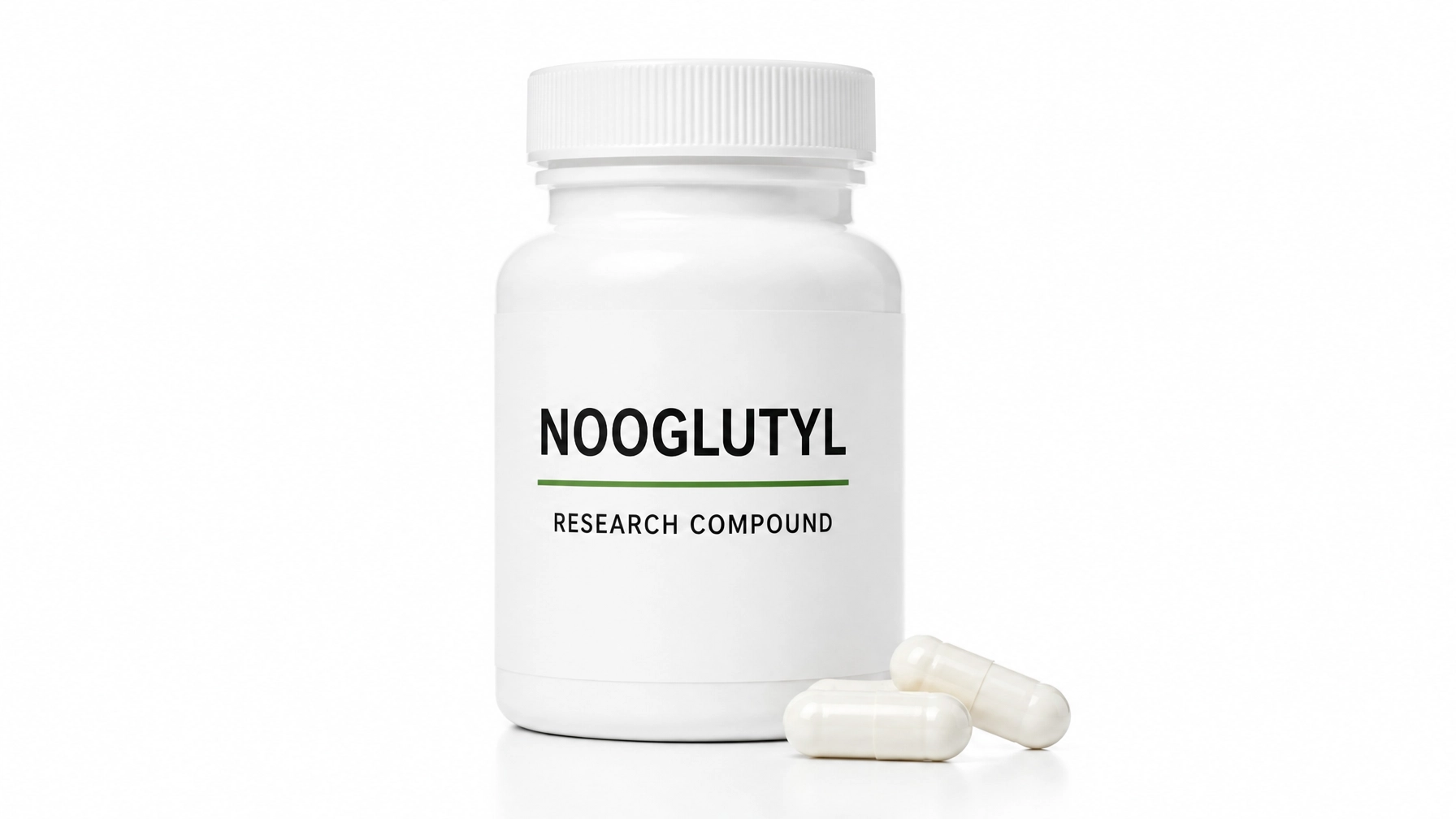
Nooglutyl: The Russian Nootropic for Memory Retention and Cognitive Stability

Research notice: Nooglutyl is an experimental compound. It is not presented here as a medicine, treatment, or approved dietary supplement. Human safety, dosing, long-term effects, and clinical effectiveness have not been established. This article is for educational research discussion only.
Your brain is not a filing cabinet that simply stores information. It is more like a busy communications network. Messages travel between nerve cells, signals are strengthened or weakened, and useful information is gradually converted into stable memories.
When that network works well, you can learn, retrieve, and apply information with less mental friction. When it becomes overloaded, your “mental filing system” can feel slow or unreliable.
This is where Nooglutyl, also known as nooglutil, has attracted interest in Russian nootropic research. The compound has been studied for its proposed effects on glutamate signalling, memory processes, and neuroprotection in animal models.
The important point is simple: Nooglutyl is a research subject, not a proven human cognitive enhancer.
What Is Nooglutyl?
Nooglutyl is a synthetic compound related structurally to L-glutamic acid, an amino acid involved in communication between nerve cells. It is also described in scientific literature as N-(5-oxynicotinoyl)-L-glutamic acid.
The compound has been investigated as a possible positive modulator of AMPA receptors. AMPA stands for α-amino-3-hydroxy-5-methyl-4-isoxazolepropionic acid receptors. These receptors help transmit fast excitatory signals in the brain.
Think of AMPA receptors as the brain’s rapid-response switches. When a signal arrives, these switches help pass the message from one neuron to the next. Learning and memory depend partly on this efficient communication.
The problem: mental signals can be difficult to study
Researchers are interested in compounds that may influence memory without simply acting as strong stimulants.
The research direction: glutamatergic signalling
Nooglutyl is studied because it may influence glutamatergic signalling: the system that uses glutamate as a chemical messenger. The goal is not to “force” the brain to work harder, but to understand whether communication between neurons can be adjusted more precisely.
WL Australia has previously included Nooglutyl 10 mg in its educational overview of nootropic capsules, where it is described as a compound of interest for precise recall and glutamate-focused cognitive research. You can read the broader nootropic capsule comparison guide.
How Could Nooglutyl Relate to Memory Retention?
Memory is not one single process. Researchers generally separate it into stages:
- Acquisition: taking in new information
- Consolidation: stabilising that information
- Storage: maintaining the memory trace
- Retrieval: accessing the information later
A useful analogy is a construction site. Acquisition is bringing materials onto the site. Consolidation is securing the structure. Storage is maintaining the finished building. Retrieval is finding the correct room when you need something.
Research involving Nooglutyl has examined several of these stages in rodents. In certain animal models of induced amnesia, the compound was reported to reduce memory impairment and support performance in learning tasks.
A PubMed-indexed study examined Nooglutyl in rats following hypoxia and reduced blood flow to the brain. The researchers reported that several nootropic compounds, including Nooglutyl, prevented or reduced memory-related disturbances in the animals. These findings are described in PMID 9606516.
A separate study examined older SAMP10 mice, a strain used in research on accelerated ageing. The researchers reported improvements in behavioural measures and retrieval of a learned response after Nooglutyl administration. You can review the abstract at PMID 18078032.
What does this mean?
It means Nooglutyl has shown memory-related activity in selected animal experiments.
It does not mean that Nooglutyl has been proven to improve memory retention in people.
Animal models are useful maps, but they are not the destination. A compound can produce a promising result in a rodent task and still fail to provide a safe or meaningful benefit in human clinical trials.

Nooglutyl and Cognitive Stability Research
The phrase cognitive stability can sound broad, so it is useful to define it clearly. In research discussions, it may refer to maintaining learning, attention, and memory performance under stress, ageing, injury, or reduced oxygen availability.
Your brain can be compared to a sports team. It needs different players to work together:
- Glutamate pathways help transmit fast signals.
- Dopamine pathways influence motivation and movement.
- Acetylcholine pathways contribute to attention and learning.
- Protective systems help manage cellular stress.
Nooglutyl research has examined how glutamate-related activity may interact with other brain systems. One PubMed study reported that Nooglutyl influenced dopamine D2 receptor measures in rats and suggested that this effect may be mediated through glutamatergic signalling. The study is available at PMID 12802448.
The problem: “focus” is often treated as simple stimulation
Feeling more alert is not the same as learning more effectively. Stimulation may increase energy while also increasing nervousness, distraction, or poor sleep.
The research solution: study signal quality
Nooglutyl is of interest because researchers are examining whether it can affect the quality and organisation of neural signalling rather than functioning only as a conventional stimulant.
The zipper analogy helps here. If the teeth of a zipper align correctly, the fastening is smooth. If they do not, the zipper catches. Researchers are exploring whether glutamate modulation could support more reliable communication during memory tasks.
That remains a hypothesis: not a confirmed human outcome.
Short summary: Nooglutyl is being investigated for signal modulation, memory retrieval, and neuroprotective potential. The evidence remains preclinical.
Neuroprotective Research: What Has Been Studied?
Neuroprotection means protecting nerve cells or brain function from damage caused by stress, injury, toxins, inflammation, or reduced oxygen supply.
In animal research, Nooglutyl has been examined in models involving:
- Hypoxia, meaning reduced oxygen availability
- Cerebral ischaemia, meaning reduced blood flow to brain tissue
- Brain injury
- Age-related cognitive changes
- Experimentally induced memory impairment
These studies are relevant because brain cells are highly dependent on energy. When oxygen or blood flow falls, the brain’s energy system can behave like a city during a power outage: essential services begin shutting down, communication becomes unreliable, and damage can spread.
Some animal studies reported improved survival, reduced memory disruption, or better neurological performance after experimental insults. However, these findings do not establish that Nooglutyl prevents stroke, treats brain injury, slows dementia, or protects people from neurological disease.
If you are experiencing memory loss, confusion, headaches, weakness, speech changes, or other neurological symptoms, seek medical assessment. Do not attempt to manage possible neurological disease with an experimental compound.

Nooglutyl Compared With Conventional Nootropics
Nooglutyl is sometimes discussed alongside compounds such as Noopept, phenylpiracetam, PRL-8-53, and other experimental nootropics. These substances are not interchangeable.
| Research subject | Main area of interest | Evidence limitation |
|---|---|---|
| Nooglutyl | Glutamate signalling, memory, neuroprotection | Human evidence and safety data are limited or unavailable |
| Noopept | Memory and neurotrophic signalling research | Evidence quality varies; not a substitute for clinical care |
| Phenylpiracetam | Alertness, performance, and cognition research | Tolerance, interactions, and regulatory concerns require caution |
| PRL-8-53 | Memory retention and recall research | Very limited human evidence |
| Semax | Neuroprotection and cognition research | Clinical status and evidence depend on jurisdiction and indication |
The practical lesson is to compare evidence quality, not just marketing language. Ask:
- Was the study conducted in animals or humans?
- Was there a control group?
- Was the study randomised?
- Were the results independently replicated?
- Is there reliable long-term safety monitoring?
- Is the substance approved for the intended use in Australia?
A promising mechanism is the starting line. It is not the finish line.
Safety, Quality, and Australian Considerations
Nooglutyl does not have an established human safety profile. Available research does not adequately answer questions about:
- Long-term neurological effects
- Drug interactions
- Effects on mood, sleep, or blood pressure
- Use during pregnancy or breastfeeding
- Effects in people with psychiatric or neurological conditions
- Appropriate human dosing
- Overdose risk
- Product purity and batch consistency
Do not treat an animal research dose as a human-use instruction. Experimental doses cannot be converted safely by simple arithmetic.
Before considering any research compound, speak with a qualified Australian health professional. You should also verify the current legal and regulatory position with the Therapeutic Goods Administration. A product being discussed online or sold in another country does not mean it is approved for therapeutic use in Australia.
For responsible research handling:
- Do not combine Nooglutyl with prescription medicines or other psychoactive compounds without medical oversight.
- Do not use it to self-treat memory loss, anxiety, depression, stroke symptoms, or brain injury.
- Do not rely on an online label as proof of identity, purity, or sterility.
- Keep records of the compound name, batch information, and research purpose.
- Store securely, away from children, pets, heat, and moisture.
- Stop and seek help if unexpected neurological, psychiatric, allergic, or cardiovascular symptoms occur.

Two Educational Video Resources
Video placeholder 1: How glutamate and AMPA receptors participate in learning and memory
Suggested format: an animated educational explainer using plain-language diagrams. Include a clear statement that receptor research does not prove a supplement or research compound improves human cognition.
Video placeholder 2: How to evaluate evidence for experimental nootropics
Suggested format: a short guide covering animal studies, human trials, product testing, Australian regulatory checks, and conversations with health professionals.
The Bottom Line on Nooglutyl
Nooglutyl is a Russian-developed experimental nootropic that has attracted research interest because of its proposed effect on AMPA receptor activity, memory processes, and neuroprotective pathways.
Animal studies suggest possible effects on:
- Memory retrieval
- Learning-related behaviour
- Hypoxia-associated memory disruption
- Ageing-related cognitive changes
- Glutamate and dopamine signalling
But the essential conclusion is just as important: there is not enough human evidence to confirm that Nooglutyl improves memory retention or cognitive stability in people, and its human safety profile remains undefined.
Use the information as a research map, not a medical shortcut. Strong cognitive performance still begins with the fundamentals: consistent sleep, regular movement, adequate nutrition, hydration, stress management, and appropriate medical care.
For further educational reading, visit the WL Australia blog or explore the WL Australia shop. Always confirm current product availability, intended research status, and Australian regulatory requirements before taking any action.

 Immune Support and Life Extension
 Shop Bioregulators & Research Chemicals for 2026 Scientific Labs
 Brain
Brain Buy Hair & Skin Care Peptides Australia – Top Quality & Best Prices
 Discover WLAustralia Peptides for Anxiety Relief & Longevity