
Adjusting the Aging Clock with Endoluten: The Pineal Gland and Melatonin Explained

Have you ever felt tired at the wrong time of day, wide awake when you should be sleeping, or unable to recover after a restless night?
Your internal body clock may be part of the story.
Deep inside your brain, a small structure called the pineal gland helps coordinate your daily rhythm. It does this largely by producing melatonin, a hormone that signals when the body should begin preparing for night-time rest.
As you age, this timing system can become less pronounced. The signal may weaken, become irregular, or lose alignment with your environment. Endoluten and Epithalon: listed by WL Australia as Epitalon: are two pineal-focused peptide bioregulators discussed in longevity research.
This article explains the science in plain English, without promising a shortcut to reverse ageing.
Important: WL Australia product pages identify Endoluten and Epitalon as research chemicals intended for laboratory use only and not for human use. This article is educational and is not a treatment guide, medical recommendation, or substitute for professional care.
Your pineal gland: the body’s timekeeper
The problem is familiar: your schedule says “sleep,” but your biology says “stay alert.”
Your body contains an internal timing system known as the circadian rhythm. “Circadian” means a cycle that follows roughly 24 hours. This rhythm influences sleep, alertness, body temperature, hormone release, metabolism, and immune activity.
Think of the circadian system as a central railway timetable. Your brain, hormones, organs, and behaviour are the trains. When the timetable is clear, everything arrives at the right time. When the signals become faint or delayed, the system becomes less coordinated.
The pineal gland acts like one of the timetable’s signal stations.
It receives information about light and darkness through the brain’s circadian network. When evening darkness arrives, the pineal gland normally increases melatonin production. In daylight, melatonin levels generally fall.
Melatonin is often called the “sleep hormone,” but that description is incomplete. It is better understood as a darkness signal. It tells your body that night has arrived and helps organise the transition toward sleep.
Short summary: Your pineal gland does not simply switch sleep on and off. It helps set the timing of your whole night-time biological programme.
Why melatonin can decline with age
The frustration is not always that you have forgotten how to sleep. Sometimes your internal night-time signal has become quieter.
The foundational chapter for this article notes that approximately 70% of adults over 60 report age-related sleep disturbances. That figure should be treated as a broad educational reference rather than proof that every sleep problem is caused by the pineal gland. Research shows that sleep disturbance is influenced by many factors, including medications, pain, stress, light exposure, shift work, menopause, urinary symptoms, breathing disorders, and mental health.
Still, ageing can affect melatonin biology.
In many people, the night-time peak of melatonin becomes lower with age. The difference between daytime and night-time levels may also become less distinct. Structural changes in the pineal gland, altered circadian signalling, and reduced activity in melatonin-producing pathways may all contribute.
Imagine a lighthouse on the coast. When the lamp is bright, ships can easily recognise the boundary between day and night. If the lamp becomes dimmer, the coastline is still there, but the signal is harder to read. Your body may still have a natural rhythm, but the transition between daytime alertness and night-time recovery may be less precise.
This can contribute to:
- More frequent night-time waking
- Earlier morning waking
- Difficulty falling asleep
- Reduced sleep continuity
- Feeling unrefreshed after a full night in bed
- Greater sensitivity to evening light, travel, or irregular schedules
The solution begins with timing. Before considering any advanced product, protect the basic signals that help your pineal gland:
- Seek bright natural light early in the day.
- Keep your wake time consistent.
- Dim artificial light in the evening.
- Limit stimulating screens close to bedtime.
- Keep your bedroom cool, quiet, and dark.
- Avoid treating persistent insomnia as a normal or unavoidable part of ageing.

Video placeholder: How the pineal gland and melatonin help organise the sleep–wake cycle
What is Endoluten?
The problem with many longevity discussions is that the language can become complicated quickly.
Endoluten is described in the foundational chapter as a natural extract derived from pineal gland tissue, containing a complex group of short peptides. Peptides are small chains of amino acids: the same basic building blocks used to make proteins.
In the bioregulator model, organ-specific peptides are viewed as biological messages. Rather than acting like a conventional stimulant or sedative, they are proposed to provide signals that help cells maintain or restore their normal functions.
A useful analogy is a maintenance request sent to a building manager. The message does not rebuild the entire building by itself. Instead, it may help direct attention to a particular system, such as lighting, heating, or structural repairs.
For Endoluten, the target discussed is the pineal and neuroendocrine system. The endocrine system is the network of glands and tissues that produce hormones. These hormones influence sleep, metabolism, stress responses, reproduction, growth, and immune activity.
The foundational chapter presents Endoluten as a pineal peptide bioregulator intended to support:
- Pineal gland function
- Natural melatonin production
- Circadian rhythm coordination
- Neuroendocrine balance
- Healthy ageing research
However, these proposed effects should not be confused with proven clinical outcomes. Endoluten is not melatonin itself, and the available evidence does not establish it as a clinically proven treatment for insomnia, ageing, menopause, or disease.
You can view the Endoluten 10mg product page for the supplier’s current product information and research-use notice.
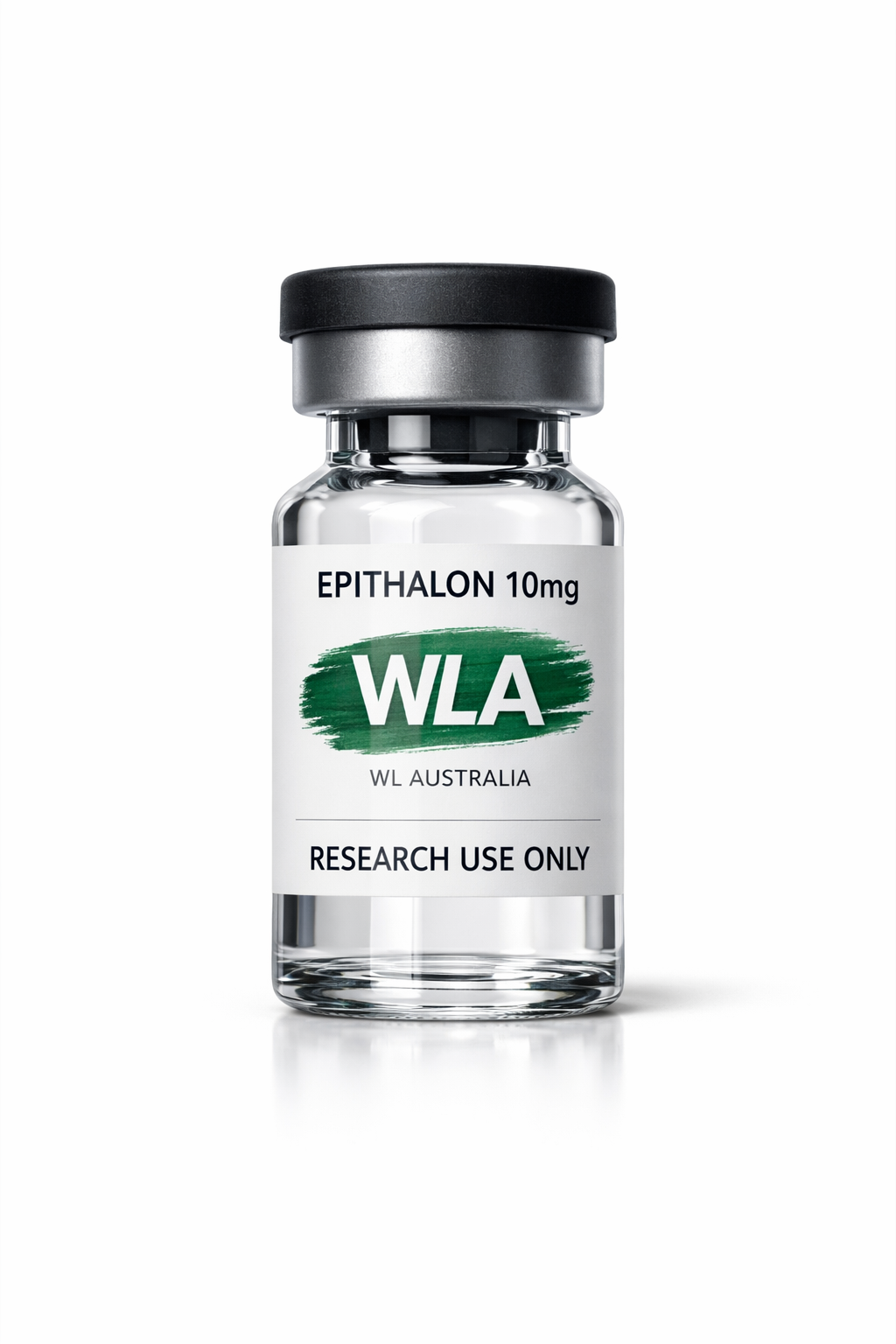
What is Epithalon, or Epitalon?
The second option is a more precisely defined synthetic peptide.
Epithalon, also commonly written as Epitalon or Epitalon peptide, has the four-amino-acid sequence Ala-Glu-Asp-Gly. In scientific shorthand, it is often written as AEDG.
Unlike Endoluten’s broader natural peptide extract, Epithalon is a synthetic tetrapeptide. “Tetrapeptide” simply means a peptide made from four amino acids.
The distinction is similar to comparing a complete toolkit with one specialised tool:
| Feature | Endoluten | Epithalon / Epitalon |
|---|---|---|
| Format described in the chapter | Natural peptide extract | Synthetic peptide |
| Biological focus | Pineal and neuroendocrine support | Pineal signalling and longevity research |
| Composition | Complex mixture of short peptides | Defined four-amino-acid sequence |
| Sequence | Not presented as a single sequence | Ala-Glu-Asp-Gly |
| Proposed research interest | Melatonin and circadian regulation | Melatonin, telomerase, and cellular ageing |
| Human-use status | Research use only | Research use only |
Epithalon has attracted attention because laboratory and early research studies have explored its relationship with melatonin secretion, circadian rhythms, and telomerase: an enzyme involved in maintaining chromosome ends called telomeres.
Telomeres can be compared with the plastic tips on shoelaces. They help protect genetic material during cell division. However, findings from cell cultures or limited early studies do not prove that Epithalon extends human lifespan or prevents age-related disease.
The sensible approach is to separate interesting biology from established medicine.
You can read the current Epitalon 10mg listing or Epitalon 20mg listing. Both pages carry the supplier’s research-chemical-only notice.
How might pineal peptides relate to the endocrine system?
The problem is that one disrupted rhythm can create a chain reaction.
Poor sleep can affect appetite, mood, energy, glucose regulation, exercise recovery, and stress tolerance. In turn, stress and irregular routines can make sleep more difficult. This is why circadian health is best viewed as a team sport rather than a single-hormone issue.
The pineal gland is one player on that team. The brain’s central clock, the adrenal glands, thyroid, reproductive hormones, immune system, and daily behaviours all contribute.
In the bioregulator framework, Endoluten and Epithalon are described as signals that may support the pineal gland’s own activity rather than simply supplying external melatonin. The proposed goal is coordination:
- Improve recognition of the day–night cycle.
- Support a clearer evening melatonin signal.
- Help align sleep and wake timing.
- Encourage more consistent downstream endocrine rhythms.
This is the idea behind “resetting” the biological clock. It does not mean turning back time or reversing every aspect of ageing. It means helping the body’s timing signals become more organised.
Pulse summary: Better timing supports recovery. Recovery supports resilience. Resilience supports healthy ageing.
A responsible approach to sleep and longevity research
If your sleep is occasionally disrupted after travel, late work, illness, or stress, begin with routine and environmental changes.
If the problem continues, investigate the cause rather than assuming you need a pineal product. Persistent insomnia may relate to:
- Sleep apnoea or loud snoring
- Restless legs
- Chronic pain
- Anxiety or depression
- Menopause or hormonal changes
- Prescription or recreational drugs
- Excess caffeine or alcohol
- Shift work or irregular schedules
- Poorly timed light exposure
Speak with a clinician if insomnia persists, affects daytime function, or is accompanied by low mood, breathing problems, severe fatigue, or other concerning symptoms.
Do not self-treat with Endoluten, Epithalon, melatonin, or other research chemicals. Do not use research products in humans or animals. In Australia, always check the current legal and regulatory position and follow the supplier’s legal disclaimer.
Video placeholder: Endoluten and Epithalon explained: natural extract versus synthetic pineal peptide
The practical takeaway
Your pineal gland is a small structure with a large coordinating role. Melatonin helps mark biological night, and its night-time rhythm often becomes less pronounced with age. That change may contribute to sleep disruption, but it is only one part of a much larger picture.
Endoluten is described as a natural pineal peptide extract. Epithalon, or Epitalon, is a synthetic tetrapeptide with the sequence Ala-Glu-Asp-Gly. Both are discussed as potential master regulators in peptide and longevity research, particularly in relation to melatonin, circadian rhythm, endocrine coordination, and cellular ageing.
The opportunity is not to chase a dramatic “age reversal” promise. It is to understand your biology, protect your daily rhythms, and evaluate emerging research carefully.
Set the clock. Protect the signal. Prioritise recovery.

 Immune Support and Life Extension
 Shop Bioregulators & Research Chemicals for 2026 Scientific Labs
 Brain
Brain Buy Hair & Skin Care Peptides Australia – Top Quality & Best Prices
 Discover WLAustralia Peptides for Anxiety Relief & Longevity