
Testicular Support and Testosterone: How Testagen Supports Natural Male Hormone Health

You wake up tired, your motivation feels lower than it used to, and your training recovery is slower. Perhaps your libido has changed too. It is easy to assume that testosterone is the only explanation.
Sometimes it is. Often, it is not.
Testosterone is one part of a larger biological team involving the brain, pituitary gland, testes, thyroid, adrenal glands, sleep system, metabolism and mental health. When one player struggles, the whole team can lose coordination.
This article explains the foundational concept behind Testagen, a synthetic peptide bioregulator associated with testicular tissue and natural testosterone production. You will also learn how it differs from Testosterone Replacement Therapy (TRT), where Libidon may fit in a broader male vitality framework, and why hormone testing and clinician supervision are essential.
Important: Testagen and Libidon are listed by WLAustralia as research chemicals: not for human use. This educational article is not medical advice, does not provide a treatment protocol, and does not suggest that either product can replace medically managed hormone therapy.
Why testosterone can change with age
The problem: symptoms that are easy to misread
Testosterone production can gradually decline with age. This does not mean every man will develop clinically low testosterone, and it does not mean that feeling tired automatically indicates a hormone problem.
Possible symptoms include:
- Reduced sexual desire
- Fewer spontaneous or morning erections
- Lower energy and stamina
- Reduced muscle strength or recovery
- Increased body fat
- Low mood or irritability
- Difficulty concentrating
- Reduced motivation
- Sleep disruption
The frustration is that these symptoms overlap with many other conditions. Poor sleep, chronic stress, depression, obesity, alcohol use, thyroid disorders, medication effects and sleep apnoea can all affect energy, mood and sexual function.
Think of your body like a dashboard. A warning light may point to the engine, but it may also reflect the battery, fuel system or electrical wiring. You need a proper inspection before replacing a part.
The solution: investigate before intervening
If you are concerned about low testosterone, speak with a qualified Australian general practitioner, endocrinologist or urologist. Diagnosis should generally combine relevant symptoms with repeatedly low blood testosterone results.
A clinician may recommend:
- Two separate morning total testosterone tests
- Free testosterone or sex hormone-binding globulin (SHBG) testing when appropriate
- Luteinising hormone (LH) and follicle-stimulating hormone (FSH)
- Prolactin and thyroid testing where indicated
- Blood count, metabolic screening and other investigations
- Assessment of sleep, medications, alcohol, exercise and fertility goals
Do not diagnose yourself from one result. Test first. Interpret with a clinician.
What is Testagen?
The problem: conventional hormone support can be misunderstood
When men hear “testosterone support,” they may think of taking testosterone from outside the body. That is the central distinction between a signalling approach and hormone replacement.
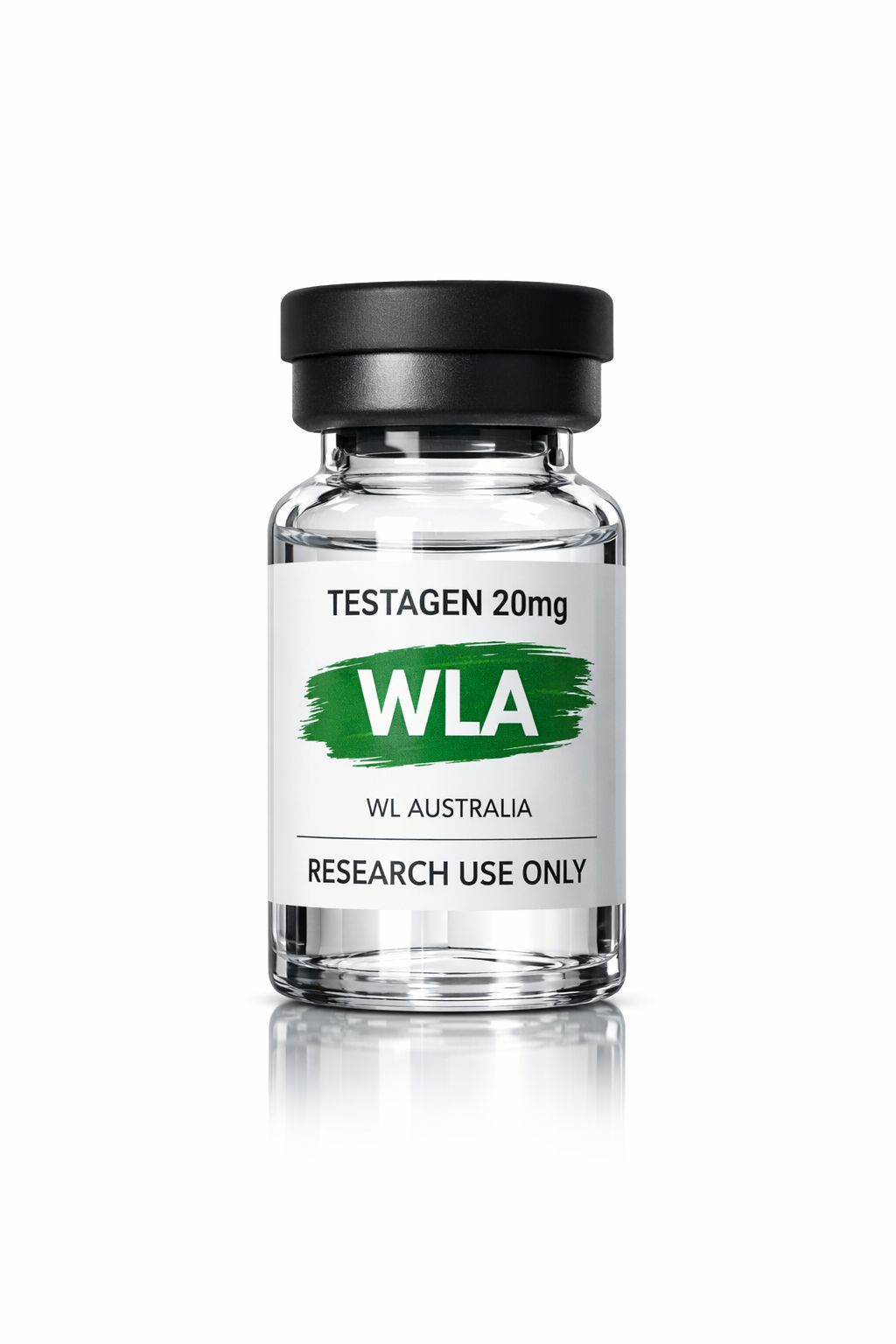
Testagen is described in the foundational chapter as a synthetic peptide bioregulator with the precise amino acid sequence:
Lys-Glu-Asp-Gly
It is also known as KEDG. A peptide is a short chain of amino acids: the same basic building blocks used to construct proteins. A synthetic peptide bioregulator is designed to act as a biological signal rather than as a replacement hormone.
The solution: a tissue-targeted signalling concept
The foundational model positions Testagen as a signal directed toward testicular tissue. The testes contain specialised cells involved in testosterone and sperm production, including Leydig cells and Sertoli cells.
Think of the testes as a manufacturing plant. Testosterone is one of the products, while the cells and enzymes inside the testes are the machinery. Testagen is presented as a short instruction note intended to support the machinery, rather than delivering finished testosterone from outside.
The proposed goal is to encourage the body’s own testicular systems to function efficiently. This is the basis for describing Testagen as supporting natural testosterone production.
However, a proposed mechanism is not the same as proven clinical effectiveness. Current mainstream guidelines do not recognise Testagen as an established treatment for male hypogonadism, and robust, high-quality human evidence demonstrating reliable testosterone, fertility or long-term health benefits is limited.
That distinction matters.
Testagen is a research concept: not a confirmed treatment for low testosterone.
Testagen and TRT: what is the difference?
The problem: confusing support with replacement
Testosterone Replacement Therapy (TRT) uses testosterone supplied from outside the body. It can be appropriate for some men with confirmed hypogonadism, persistent symptoms and a clear clinical indication.
But external testosterone can also reduce the body’s own signalling.
Your hormone system works like a thermostat. The brain monitors circulating testosterone and adjusts signals to the testes through the hypothalamic-pituitary-gonadal (HPG) axis. The hypothalamus and pituitary act like the control room, while the testes act like the production floor.
When external testosterone raises the “room temperature,” the control room may reduce its instructions. This can lower gonadotropin-releasing hormone (GnRH), LH and FSH. As a result, the testes may produce less testosterone locally and sperm production may fall.
TRT can therefore:
- Suppress the body’s natural testosterone signalling
- Reduce sperm production
- Affect fertility while being used
- Require monitoring of testosterone levels and blood count
- Require appropriate prostate and cardiovascular assessment
TRT is not inherently wrong. It is a medical therapy that must be prescribed and monitored when indicated.
The solution: match the intervention to the diagnosis
| Approach | What it is | Main consideration |
|---|---|---|
| Testagen | Experimental synthetic tetrapeptide, Lys-Glu-Asp-Gly | Proposed testicular signalling; not an approved treatment and listed for research use only |
| TRT | Clinician-prescribed testosterone replacement | Can relieve confirmed deficiency but may suppress natural production and sperm formation |
| Lifestyle and medical review | Sleep, weight, exercise, medication and health assessment | May identify reversible causes of testosterone-related symptoms |
Before considering TRT or any research peptide, define the problem. Are you dealing with genuine hypogonadism, poor sleep, medication effects, stress, metabolic health issues or another condition?
Diagnosis comes before optimisation.
Where Libidon fits in male vitality discussions
The problem: treating male vitality as one single system
Testosterone and prostate health are connected to male wellbeing, but they are not the same biological function.
The testes are involved in testosterone and sperm production. The prostate contributes to reproductive function and sits below the bladder, surrounding part of the urethra. Age-related prostate changes can affect urinary comfort, flow and sleep.
This is why focusing only on testosterone may leave part of the picture unaddressed.
The solution: understand the roles of different products
Libidon is described as a natural peptide bioregulator associated with prostate tissue. The WLAustralia product page identifies it as a 10 mg product containing an A-16 prostate amino acid complex derived from bovine sources.

In the foundational framework, Libidon is intended to support prostate tissue, while Testagen is directed toward testicular tissue. The suggested combination is therefore based on complementary targets:
- Testagen: testicular tissue and the concept of natural testosterone support
- Libidon: prostate tissue and male reproductive function
- Together: broader organ-focused male vitality support
Picture a sports team. Testagen is assigned to the training department, while Libidon is assigned to facilities and logistics. Supporting one department does not automatically repair the other. Coordination may be useful conceptually, but every player still needs medical assessment and appropriate oversight.
The combination should not be treated as a self-directed stack, dosage plan or alternative to diagnosis. Both products are listed as research chemicals: not for human use on their respective WLAustralia pages.
Learn more through the Testagen 20mg product page and Libidon 10mg product page.

A responsible male hormone health framework
The problem: chasing a number instead of improving health
A testosterone result is important, but it is not the whole story. A man can have a borderline result and significant symptoms, or a low result caused by a reversible issue.
You should also consider:
- Seven to nine hours of consistent sleep
- Screening for sleep apnoea if you snore or feel unrefreshed
- Resistance training and regular physical activity
- Adequate protein and overall nutrition
- Healthy body composition
- Moderating alcohol
- Reviewing medicines and supplements
- Managing chronic stress
- Discussing fertility before any hormone treatment
The solution: use a tiered process
- Record your symptoms. Note changes in libido, erections, energy, mood, sleep and recovery.
- Book a clinical review. Bring your symptom history, medications and family history.
- Complete appropriate testing. Follow your clinician’s advice regarding morning hormone testing and follow-up investigations.
- Address reversible factors. Treat sleep, metabolic, psychological or medication-related contributors where relevant.
- Discuss treatment options. If hypogonadism is confirmed, review evidence-based options and fertility implications.
- Treat research products cautiously. Do not use Testagen or Libidon as a substitute for medical care, and disclose any products you are considering to your clinician.
Video placeholder: Testagen Explained: Testicular Signalling, Testosterone and the HPG Axis
Video placeholder: Male Vitality Check-In: Hormone Testing, Fertility and Prostate Health
Final perspective
Age-related changes in testosterone can be frustrating, but they are not a reason to guess. Your biology is a network, not a single switch.
Testagen is presented as a synthetic peptide bioregulator with the sequence Lys-Glu-Asp-Gly, designed around the concept of supporting testicular tissue and natural hormone production. Libidon is positioned around prostate tissue, creating a proposed complementary framework for male vitality.
The responsible path is clear: test symptoms, investigate causes, protect fertility, involve a clinician and understand the regulatory status of every product.
No peptide should be presented as a replacement for medically managed hormone therapy. If you have persistent symptoms or abnormal results, speak with a qualified health professional before starting, stopping or changing any hormone-related treatment.
Better male health begins with informed decisions, not shortcuts.
For general information only. Always seek advice from an appropriately qualified healthcare professional. Product information and regulatory status may change; review the current WLAustralia legal information before making decisions.

 Immune Support and Life Extension
 Shop Bioregulators & Research Chemicals for 2026 Scientific Labs
 Brain
Brain Buy Hair & Skin Care Peptides Australia – Top Quality & Best Prices
 Discover WLAustralia Peptides for Anxiety Relief & Longevity