AKG 500mg Capsules: The Longevity Metabolite for Cellular Energy and Anti-Aging Research

Important: WLA Australia lists AKG 500mg x 60 caps as research chemical only, not for human use. This article is educational and does not provide directions for personal use, dosing, treatment, or disease prevention.
Why AKG is attracting longevity researchers
The frustration in ageing research is simple: ageing is not controlled by one switch. It is more like a large construction site, with energy supply, waste removal, inflammation, DNA regulation and tissue repair all operating at once.
Alpha-ketoglutarate, commonly abbreviated as AKG, is attracting attention because it sits at the centre of several of these systems. It is an endogenous metabolite, meaning your cells naturally produce it. It is also known as 2-oxoglutarate.
Researchers study AKG because it connects:
- Mitochondrial energy production
- Amino-acid and nitrogen metabolism
- Redox balance, which describes the movement between oxidation and reduction
- Epigenetic regulation, or chemical controls that influence gene activity without changing the DNA sequence
- Cellular ageing and inflammation
That does not mean AKG has been proven to extend human life. It means the molecule occupies an important biological junction: like a roundabout where several major roads meet.
The research goal: understand whether changing AKG availability can influence healthspan, cellular resilience and age-related decline.
What is AKG?
AKG is a five-carbon molecule found inside cells, particularly within the mitochondria. Mitochondria are often described as the cell’s power stations, but a more useful analogy is a hybrid engine: they process fuel, respond to demand and supply energy in different forms.
AKG performs several roles at the same time:
- It acts as an intermediate in the Krebs cycle.
- It provides a carbon framework for producing amino acids such as glutamate and glutamine.
- It participates in nitrogen handling.
- It serves as a required co-substrate for enzymes involved in oxygen sensing, collagen formation and epigenetic regulation.
In practical research terms, AKG is not merely “an energy ingredient”. It is a metabolic messenger and raw material.

AKG and the Krebs cycle: the cellular energy circuit
The Krebs cycle, also called the tricarboxylic acid cycle (TCA cycle) or citric acid cycle, is a circular series of reactions inside mitochondria. Its job is to extract usable energy from carbohydrates, fats and amino acids.
Think of it as a high-efficiency power-generation circuit:
- Nutrients are broken down into smaller fuel molecules.
- These molecules enter the cycle.
- The cycle produces electron carriers, mainly NADH and FADH₂.
- The electron carriers deliver energy to the respiratory chain.
- The respiratory chain helps generate adenosine triphosphate (ATP), the cell’s immediate energy currency.
AKG enters the cycle after isocitrate is converted by an isocitrate dehydrogenase enzyme. It is then converted into succinyl-CoA by the AKG dehydrogenase complex. This step produces NADH, which later contributes to ATP production.
A simplified sequence looks like this:
| Krebs cycle stage | Research significance |
|---|---|
| Isocitrate → AKG | Produces a central metabolic intermediate |
| AKG → Succinyl-CoA | Generates NADH and continues energy flow |
| NADH → Respiratory chain | Transfers electrons for ATP production |
| AKG ↔ Glutamate | Links energy metabolism with amino-acid metabolism |
The problem: when mitochondrial systems become less efficient, energy production can become harder to maintain.
The research solution: study central metabolites such as AKG to determine whether they can support metabolic flexibility. This is not the same as proving that an AKG capsule improves energy in people. It is a mechanistic question requiring controlled studies.
Video placeholder 1: Explainer video showing the Krebs cycle as a cellular energy circuit, with AKG highlighted between isocitrate and succinyl-CoA.
Beyond energy: AKG as a cellular building material
AKG also works like a construction material. Its carbon structure can be redirected into amino-acid pathways, including the production of glutamate and glutamine.
These amino acids contribute to:
- Protein synthesis
- Nitrogen transport
- Antioxidant systems
- Intestinal and immune-cell metabolism
- Tissue maintenance and repair pathways
AKG also supports a family of enzymes called 2-oxoglutarate-dependent dioxygenases. These enzymes require AKG, oxygen and iron to complete their reactions.
Some members of this enzyme family help regulate:
- Hypoxia-inducible factor (HIF), a system that helps cells respond to low oxygen
- Ten-eleven translocation (TET) enzymes, which participate in DNA demethylation
- Jumonji C domain-containing enzymes, which influence histone demethylation
- Prolyl hydroxylases, which contribute to collagen formation and oxygen sensing
A useful analogy is a zipper. DNA and histone marks can affect how tightly genetic information is closed or opened. AKG-dependent enzymes help regulate parts of that “zipper”, although the process is highly complex and cannot be reduced to a single anti-ageing switch.
What does AKG research say about ageing?
The problem: promising laboratory results can be overstated
Longevity research often begins in simple organisms or laboratory models. These models are valuable, but they are not people. A result in a worm, fly, mouse or cell culture is an early signal: not a finished health recommendation.
The research solution: separate evidence by level
| Evidence level | What researchers have observed | What it does not prove |
|---|---|---|
| Cell studies | Changes in pathways linked to senescence, inflammation and metabolism | A clinical benefit in humans |
| Worm and fly studies | AKG-related lifespan effects in model organisms | Human lifespan extension |
| Mouse studies | Healthspan, frailty and inflammatory changes with calcium AKG | That this specific product produces the same effect |
| Human studies | Early safety and biological-age signals in limited research | Prevention of ageing-related disease |
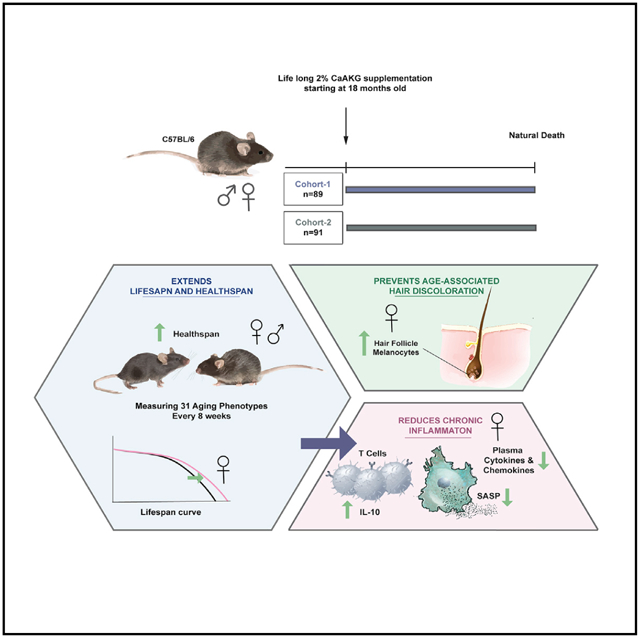
A widely discussed Cell Metabolism study examined calcium AKG, or CaAKG, in middle-aged mice. The researchers reported longer lifespan in female mice and improved healthspan measures in both sexes. The study also identified reductions in several inflammatory signals.
However, the intervention involved a controlled mouse diet and calcium AKG, not the WLA Australia AKG 500mg capsule product. The findings therefore provide biological context, not a product-specific human claim. You can read the open-access study here.
Research in Caenorhabditis elegans: a microscopic worm commonly used in ageing studies: has also linked AKG with lifespan pathways involving ATP synthase and TOR, short for target of rapamycin. These findings helped establish AKG as a candidate molecule in geroscience, the study of biological ageing.
Human evidence remains early. One open-label study reported changes in DNA-methylation age after use of a formulation containing AKG and vitamins. Because the study was small, lacked a placebo group and used a multi-ingredient formulation, it cannot establish that AKG alone reverses ageing or extends life. A separate randomised trial protocol is investigating calcium AKG in middle-aged adults; its design is available through this published protocol.
The short version: AKG is promising in models, but human longevity benefits remain unproven.
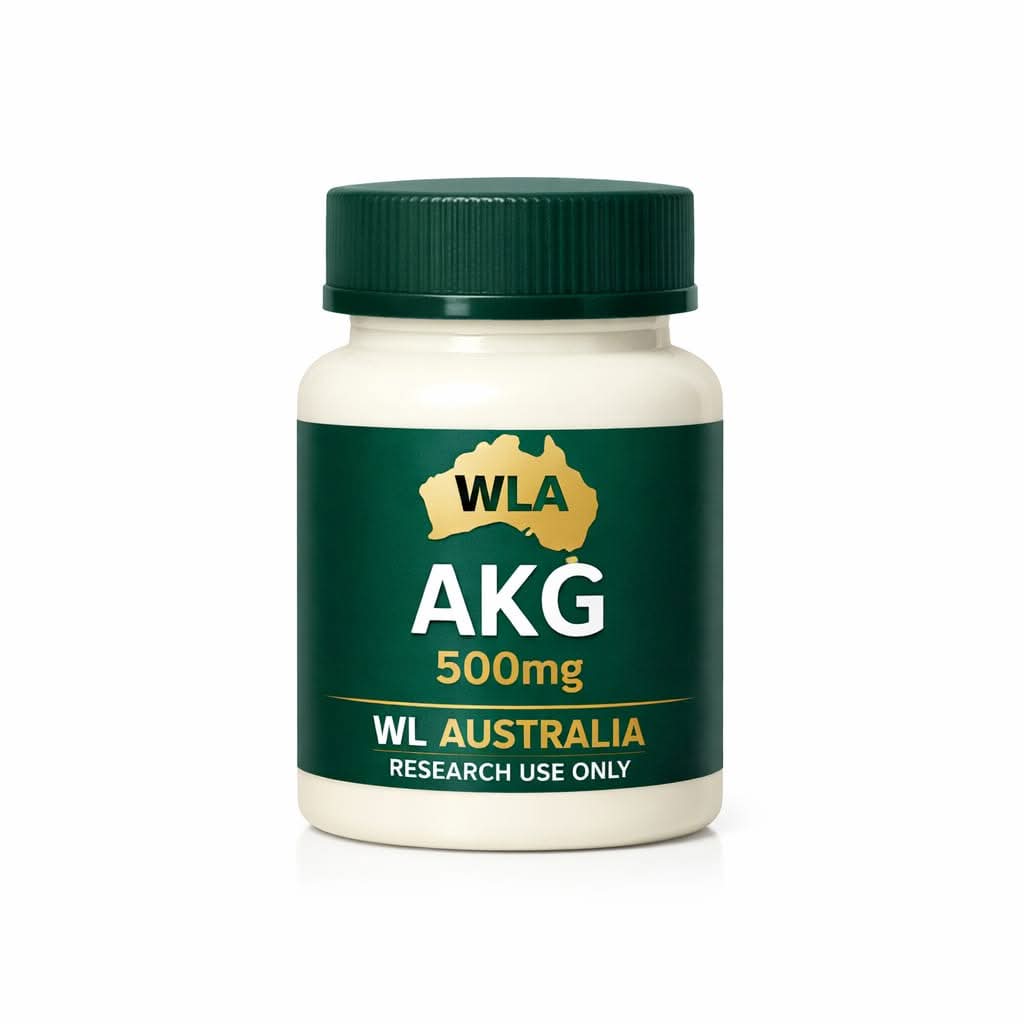
AKG 500mg x 60 caps: product spotlight
The AKG 500mg x 60 caps product page lists:
- 500mg AKG per capsule
- 60 capsules per bottle
- Research use only
- Not for human use
This format may be relevant to laboratories, analytical work, formulation research or other approved research settings. It should not be interpreted as a consumer supplement recommendation.
The distinction between AKG forms also matters. Published studies may use:
- Free-form AKG
- Calcium AKG
- Sodium AKG
- Ornithine AKG
- Cell-permeable AKG derivatives
These are not interchangeable. A result involving calcium AKG does not automatically apply to free-form AKG, and a result involving a specialised laboratory derivative does not automatically apply to an oral capsule.
Research quality depends on matching the molecule, dose, delivery method and study population.
Video placeholder 2: Product overview video showing the AKG 500mg x 60 caps bottle, its research-use-only label and the difference between AKG forms used in published studies.
Safety, handling and Australian compliance
The problem: research chemicals can be mistaken for ordinary supplements
A capsule format can look familiar, but appearance does not determine legal status, intended use or suitability. Research products must be handled according to their label, documentation and institutional procedures.
The responsible solution: use a tiered compliance process
Before any approved research activity:
- Check the product label and documentation.
- Confirm the intended use with your laboratory or research supervisor.
- Review storage, handling and record-keeping requirements.
- Assess interactions with other substances, equipment or study protocols.
- Obtain qualified medical, scientific or regulatory advice where required.
- Check current Australian requirements through the Therapeutic Goods Administration.
Human studies of AKG salts have reported generally tolerable short- to medium-term use under controlled conditions. That evidence does not establish the safety of this specific product for human consumption, and it does not override the product’s not-for-human-use warning.
People with kidney or liver conditions, people taking prescription medicines, and pregnant or breastfeeding individuals should not treat research literature as personal medical advice.
Store the product securely, keep it in its original packaging and prevent access by children or anyone who may mistake it for a general supplement.
Final perspective: a promising metabolite, not a proven anti-ageing treatment
AKG is an important part of the Krebs cycle and a useful research molecule because it connects energy production, amino-acid metabolism, oxygen sensing and epigenetic regulation.
The evidence is strongest in laboratory models. Animal studies suggest potential effects on healthspan, frailty and inflammation. Human research is still developing, and no reliable evidence currently proves that AKG extends human lifespan or prevents age-related disease.
For approved research, the AKG 500mg x 60 caps listing provides the product specifications. For broader product information, visit the WLA Australia shop.
Understand the pathway. Match the evidence. Respect the label. Safety comes first.

 Immune Support and Life Extension
 Shop Bioregulators & Research Chemicals for 2026 Scientific Labs
 Brain
Brain Buy Hair & Skin Care Peptides Australia – Top Quality & Best Prices
 Discover WLAustralia Peptides for Anxiety Relief & Longevity