GLOW Capsules: BPC-157, GHK-Cu & TB-500 : The Skin, Hair and Healing Beauty Stack

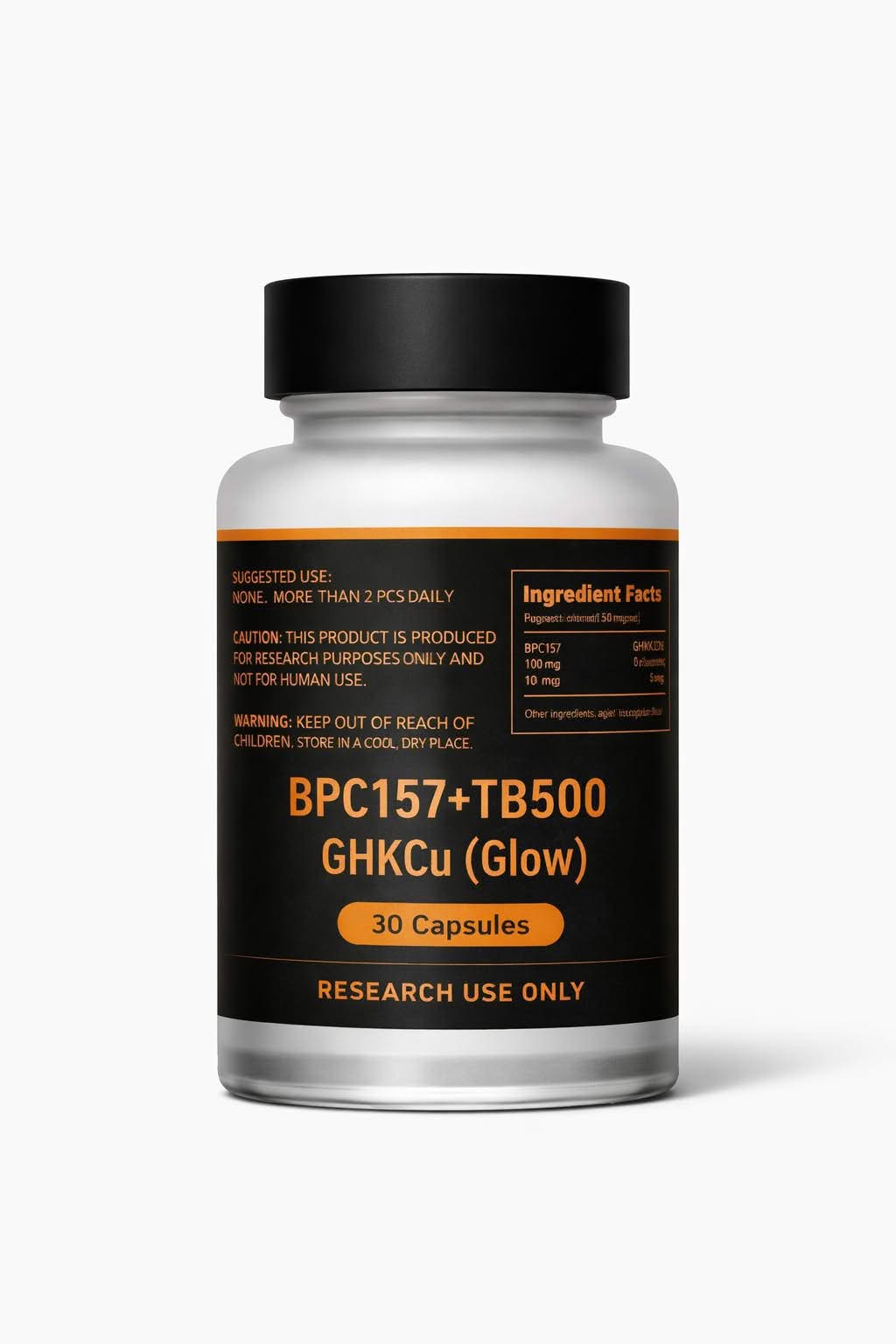
GLOW capsules bring together three research compounds often discussed in connection with tissue repair, collagen biology, skin quality, hair follicles and recovery: BPC-157, GHK-Cu and TB-500.
Each capsule is listed as containing:
- 500 micrograms BPC-157
- 500 micrograms TB-500
- 2 milligrams GHK-Cu
You can view the current listing on the GLOW capsules product page.
However, start with the most important point: wlaustralia lists GLOW capsules as a research chemical only: not for human use. This article is an educational overview of the compounds and the research questions surrounding them. It is not medical advice, a treatment guide or directions for taking the product.
Video placeholder 1 : GLOW capsules overview: Insert a short product video explaining the three compounds, the labelled composition and the research-only status.
Why combine three compounds?
Skin, hair and healing are not controlled by one biological switch. Think of your body as a large construction site.
- BPC-157 is researched in relation to repair signalling and inflammation.
- GHK-Cu is studied in relation to collagen, extracellular matrix and skin biology.
- TB-500 is researched in relation to cell movement and tissue remodelling.
The theory behind a combination is easy to understand: one compound may be associated with the repair message, another with the building materials and another with how cells move through damaged tissue.
But a useful theory is not the same as proven synergy. Synergy means that combined effects are greater than the effects of each component separately. At present, robust human trials have not established that GLOW capsules produce this outcome.
The Australian Therapeutic Goods Administration (TGA) identifies BPC-157, GHK-Cu and TB-500 among unapproved peptide products that have not been assessed for safety, quality or effectiveness. The TGA’s guidance on unapproved peptide products is essential reading.
What is BPC-157?
The problem researchers are investigating
When tissue is injured, the body must coordinate inflammation, blood flow, cell migration and rebuilding. If this process becomes prolonged or poorly coordinated, recovery may be slow.
BPC-157 is a laboratory peptide fragment that has attracted interest because animal and cell research has examined its relationship with:
- Inflammatory signalling
- Blood-vessel formation
- Connective-tissue repair
- Gastrointestinal and soft-tissue models
- Cell survival and migration
A simple analogy is a site manager coordinating an emergency repair. BPC-157 is often discussed as a possible signal involved in organising activity around damaged tissue.
What the evidence actually shows
Most BPC-157 evidence remains preclinical, meaning it comes from laboratory or animal studies rather than reliable human clinical trials. Human research is limited, and there are no large, high-quality trials establishing appropriate use, effectiveness or long-term safety.
BPC-157 is also subject to Australian regulatory restrictions. It should not be treated as an ordinary beauty supplement simply because it is sold in capsule form or described online as “research-only”.
What is GHK-Cu?

The problem researchers are investigating
Collagen is one of the main structural proteins in skin. It helps provide strength and support, much like the steel framework inside a building. With age, environmental exposure and normal wear, the skin’s repair and renewal systems can change.
GHK-Cu stands for glycyl-L-histidyl-L-lysine copper, commonly called a copper peptide. It is a naturally occurring peptide associated with copper and has been studied for possible roles in:
- Collagen and extracellular-matrix activity
- Skin repair
- Inflammatory signalling
- Wound-healing models
- Hair-follicle and scalp research
The extracellular matrix is the supportive network around cells. You can picture it as the scaffolding, wiring and insulation surrounding a construction project.
Skin and hair claims need careful interpretation
GHK-Cu is frequently discussed in cosmetic skincare, particularly in topical products such as serums. That does not automatically prove that an oral research capsule has the same effect.
Research involving topical formulations, cells or animals cannot be directly converted into a guaranteed result for a human capsule. The wlaustralia GHK-Cu product page also identifies its product as research chemical only and not for human use.
For hair, the research question is whether copper-peptide activity may influence scalp environment, follicle signalling or the behaviour of dermal papilla cells. Hair growth, however, depends on many variables, including genetics, hormones, nutrition, inflammation and scalp health.
There is no established human evidence that GHK-Cu capsules restore hair or reverse hair loss.
What is TB-500?
The problem researchers are investigating
Healthy repair requires cells to move into the area that needs attention. Imagine a sports team responding to an injury: players must reach the right location, communicate and perform their roles in sequence.
TB-500 is commonly marketed as a synthetic fragment related to thymosin beta-4. Research discussions often focus on possible links with:
- Cell migration
- Tissue remodelling
- Wound-healing pathways
- Blood-vessel development
- Recovery models
These mechanisms are scientifically interesting, but they remain mechanisms under investigation: not proof of a cosmetic or medical outcome.
What remains unknown
TB-500 has no established TGA-approved therapeutic indication for routine consumer use. Reliable human data on long-term safety, appropriate dosing, interactions and combination use are limited.
This is particularly important when TB-500 is combined with other biologically active compounds. A blend may introduce additional uncertainty because the body is exposed to multiple signals at once.
How the three-part GLOW concept fits together

The GLOW formula can be understood as a three-part research concept:
| Component | Main research theme | Plain-English analogy | Human evidence |
|---|---|---|---|
| BPC-157 | Repair and inflammatory signalling | The site manager | Limited and low quality |
| GHK-Cu | Collagen and matrix biology | The structural framework | Mostly preclinical |
| TB-500 | Cell movement and remodelling | The repair team moving into position | No robust routine-use evidence |
The potential appeal is clear: repair, structure and recovery in one labelled blend.
The limitation is equally clear: the combination has not been proven through high-quality, long-term human trials for skin, hair or healing. Marketing language can make a pathway sound like a result. Biology is more complicated.
Skin, hair and healing: what should you focus on first?
If your concern is skin ageing
Problem: Fine lines, dryness, pigmentation or reduced elasticity can have many causes.
Tiered solution:
- Use evidence-based sun protection and avoid excessive ultraviolet exposure.
- Maintain a simple, consistent skincare routine.
- Speak with a qualified GP or dermatologist about persistent changes.
- Do not assume an unapproved peptide blend is a substitute for diagnosis or proven dermatological care.
Australian sunlight is a major environmental factor, even during cooler months. Daily sun protection is often a more reliable foundation than chasing an experimental “glow”.
If your concern is hair thinning
Problem: Hair loss may reflect androgenetic alopecia, thyroid disease, iron deficiency, medication effects, autoimmune conditions or scalp inflammation.
Tiered solution:
- Arrange a proper assessment rather than guessing the cause.
- Review nutrition, sleep, stress and medications with a health professional.
- Ask about established hair-loss treatments where appropriate.
- Treat sudden, patchy or painful hair loss as a reason for prompt medical review.
A peptide marketed for follicles cannot replace a diagnosis.
If your concern is slow healing
Problem: Wounds that remain painful, red, swollen or open may require urgent attention.
Tiered solution:
- Follow professional wound-care instructions.
- Seek medical care for worsening redness, pus, fever, severe pain or spreading inflammation.
- Check factors such as diabetes, circulation, smoking, nutrition and prescribed medicines.
- Never use a research chemical as a substitute for wound assessment.
Recovery begins with diagnosis. Optimisation begins with safety.
Video placeholder 2 : Skin, hair and healing research: Insert an educational video explaining the difference between preclinical findings, human clinical evidence and approved treatment.
Australian safety and regulatory context
The TGA and Australian medical experts have warned about unapproved peptide products, including concerns involving:
- Unknown purity and manufacturing standards
- Incorrect or inconsistent labelled doses
- Contamination
- Drug interactions
- Severe allergic reactions
- Inflammation and liver injury
- Unknown long-term effects
The UNSW evidence review on injectable peptides explains that many claims are based on cell or animal research rather than strong human trials.
The fact that GLOW capsules are swallowed rather than injected does not remove the central issues of approval, quality, safety or evidence. Route of administration changes one risk category; it does not turn a research chemical into an approved medicine.
If you are considering any peptide product, speak with a qualified Australian health professional first. If you experience a concerning reaction after exposure to an unapproved product, seek medical care promptly.
Final perspective
GLOW capsules combine three compounds that are frequently discussed in the research world of skin biology, hair follicles and tissue repair. BPC-157, GHK-Cu and TB-500 each have interesting proposed mechanisms, but the evidence remains limited and largely preclinical.
The responsible takeaway is simple:
- Understand the biology.
- Separate mechanism from proven benefit.
- Check Australian regulatory status.
- Prioritise diagnosis and medical oversight.
- Do not treat research-only products as supplements or medicines.
For the current product description and labelled composition, visit the GLOW capsules listing. You can also browse the wider wlaustralia shop for research products and educational information.

 Immune Support and Life Extension
 Shop Bioregulators & Research Chemicals for 2026 Scientific Labs
 Brain
Brain Buy Hair & Skin Care Peptides Australia – Top Quality & Best Prices
 Discover WLAustralia Peptides for Anxiety Relief & Longevity