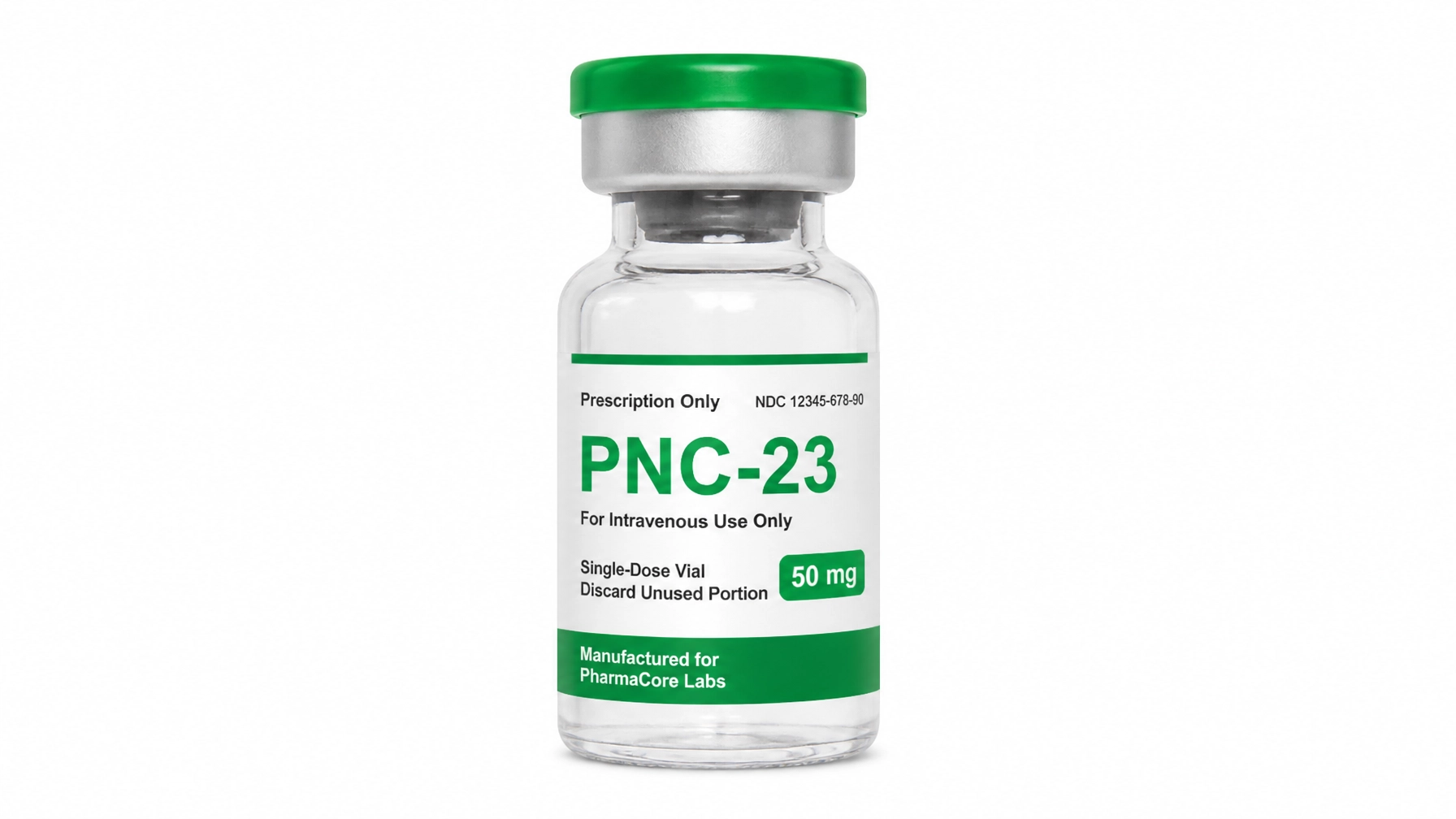
PNC-23: The Targeted Research Peptide for Cellular Health Applications

Maintaining optimal cellular health is much like managing a high-security construction site. Every day, thousands of "workers" (cells) perform vital tasks, and a specialized team of "security guards" (p53 proteins) patrols the perimeter to ensure no rogue elements or damaged structures are allowed to remain. In a perfect system, these guards identify a faulty brick and remove it immediately.
However, as we age or face environmental stressors, these security guards can be "handcuffed" by a sneaky supervisor known as HDM2 (Human Double Minute 2). When the guards are restrained, damaged cells begin to accumulate, leading to a decline in systemic efficiency. PNC-23 is a cutting-edge research peptide designed to act as the "key" to these handcuffs, potentially restoring the natural quality control of the body.
In this guide, you will learn how this targeted therapeutic works, its unique mechanism for identifying "rogue" cells, and how to safely handle it within a research framework.
The Problem: The "Handcuffed" Security Guard
Every cell in your body contains p53, a protein so critical to cellular health that scientists call it the "Guardian of the Genome." Its primary job is to monitor DNA damage. If the damage is fixable, p53 pauses the cell for repairs; if it is beyond saving, p53 triggers a controlled shutdown.
The frustration: In many compromised cellular environments, the body overproduces HDM2. Think of HDM2 as a piece of tape placed over the "security guard's" mouth and hands. HDM2 binds to p53, marking it for destruction before it can do its job. This allows "rogue" cells: those that are damaged or behaving erratically: to stay on the "construction site," consuming resources and creating structural instability.
The Solution: PNC-23 is engineered specifically to target this HDM2/p53 interaction. By mimicking the specific part of p53 that HDM2 likes to grab, PNC-23 acts as a decoy. It occupies the HDM2 molecule, preventing it from binding to your natural p53 guards.
[PLACEHOLDER: VIDEO 1 – THE MECHANISM OF P53 AND HDM2 INTERACTION]
How PNC-23 Operates: The "Poptosis" Effect
While many supplements aim to boost general health, PNC-23 is highly surgical. It doesn't just "support" cells; it helps the body identify which ones need to be retired. Unlike its predecessor, PNC-27, which is a longer chain, PNC-23 is a truncated, more streamlined version designed for high-efficiency binding.
The Membrane Target
One of the most fascinating aspects of PNC-23 research is its selectivity. Research suggests that compromised or "rogue" cells often misplace their HDM2. Instead of keeping it inside the control center (the nucleus), they push it out to the cell's outer wall (the plasma membrane).
- Target Acquisition: PNC-23 ignores healthy cells where HDM2 is tucked away safely inside.
- Binding: It seeks out the "misplaced" HDM2 on the surface of rogue cells.
- Pore Formation: Once it binds, it creates tiny punctures or "pores" in the cell wall.
- Rapid Clearance: This process, known as Poptosis (a unique form of pore-induced cell death), causes the rogue cell to lose pressure and dissolve quickly, leaving the surrounding healthy tissue untouched.

Understanding the Research Hierarchy
To navigate the world of advanced peptides, you must understand where PNC-23 fits in the hierarchy of cellular optimization.
| Feature | PNC-23 (The Modern Analog) | PNC-27 (The Original) |
|---|---|---|
| Structure | Shorter, 23-amino acid chain | 32-amino acid chain |
| Efficiency | Faster binding, potentially lower metabolic load | Standard binding |
| Target | Membrane-expressed HDM2 | Membrane-expressed HDM2 |
| Primary Goal | Selective cellular clearance | Selective cellular clearance |
Focus on this: PNC-23 represents the "Version 2.0" of HDM2-targeting research. By shortening the peptide chain, researchers aim to achieve the same surgical precision with a molecule that is easier for the biological system to process and utilize in a laboratory setting.
Regional Context: The Australian Landscape
In Australia, the landscape for advanced research peptides is strictly regulated to ensure safety and quality. When you source materials like PNC-23, you are participating in a global frontier of biology. It is vital to recognize that within the Australian framework, these compounds are designated for research purposes.
Take control of your biology responsibly. In the local climate, where UV exposure and environmental factors can accelerate cellular stress, the research into p53-stabilizing agents is particularly relevant. Always ensure your research adheres to the guidelines set out by the Therapeutic Goods Administration (TGA) regarding the handling of unapproved therapeutic goods for laboratory use.

Practical Safety and Maintenance
Research requires precision. If you are handling PNC-23, you must treat it with the same respect a mechanic treats a high-performance engine. One wrong move doesn't just stall the project; it wastes the potential of the compound.
1. Reconstitution: The "Fuel Mix"
PNC-23 usually arrives as a lyophilized (freeze-dried) powder. To activate it, you must add Bacteriostatic Water.
- The Problem: Shaking the vial can "break" the delicate peptide chains.
- The Solution: Tilt the vial and let the water slide down the glass wall. Gently swirl: never shake.
2. Storage: The "Coolant System"
Peptides are temperature-sensitive.
- Unopened vials: Can stay at room temperature for short periods but prefer a cool, dark place.
- Reconstituted vials: Must be stored in the refrigerator (2°C to 8°C). Like a fresh carton of milk, once it's "opened" (reconstituted), the clock starts ticking.
3. Verification
Always source from reputable providers within the wlaustralia shop. Look for high-purity certifications to ensure your research isn't compromised by fillers or heavy metals.
[PLACEHOLDER: VIDEO 2 – STEP-BY-STEP PEPTIDE RECONSTITUTION GUIDE]
The "Pulse" Summary: Why PNC-23 Matters
- Synergy: It works in harmony with the body's natural p53 "security guards."
- Recovery: By clearing out "rogue" cells, it may reduce the overall "biological noise" in a system.
- Optimization: It shifts the focus from "surviving" to "thriving" at a cellular level.
Consider this: if your body is a library, and some of the books have torn pages and ink spills (damaged cells), PNC-23 is the librarian that identifies the damaged copies so they can be replaced with brand-new ones.

Conclusion: Unlocking Your Biological Potential
PNC-23 is more than just a sequence of amino acids; it is a tool for understanding the very foundations of how our bodies maintain order. By targeting the HDM2 "handcuffs," this peptide opens new doors for research into longevity, recovery, and cellular integrity.
Whether you are exploring the vast catalog of bioregulators or diving deep into all available products, remember that knowledge is the ultimate catalyst for change. Ground your research in safety, follow the logic of the "security guard" analogy, and take the first step toward mastering your biology.

 Immune Support and Life Extension
 Shop Bioregulators & Research Chemicals for 2026 Scientific Labs
 Brain
Brain Buy Hair & Skin Care Peptides Australia – Top Quality & Best Prices
 Discover WLAustralia Peptides for Anxiety Relief & Longevity