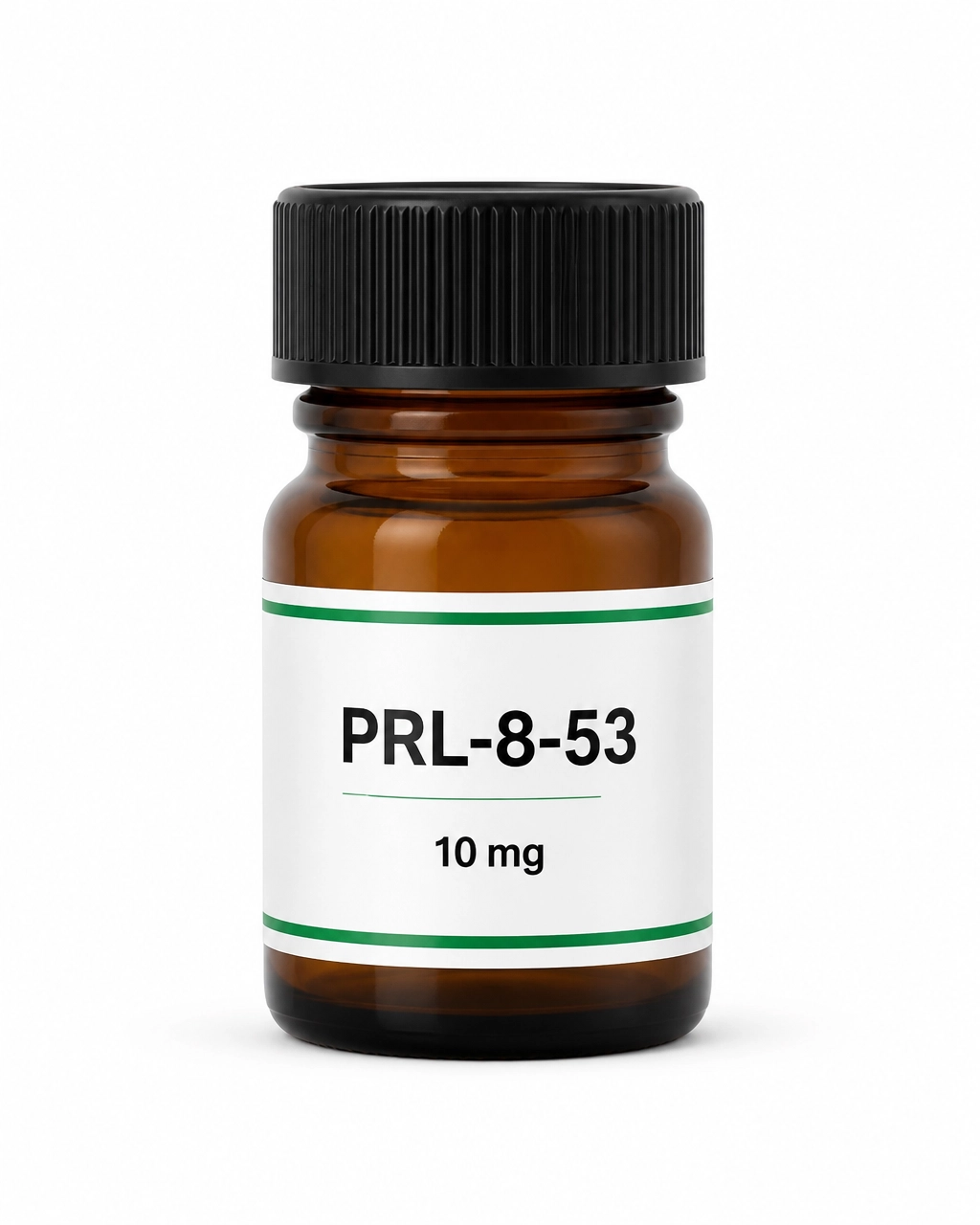
PRL-8-53: The Memory-Enhancing Compound for Recall and Learning Research

You remember information best when three stages work together: learning, retention, and recall. If one stage breaks down, the experience can feel familiar: you read a page, attend a meeting, or study a new topic, but the details seem to disappear when you need them.
PRL-8-53 is an investigational nootropic: a compound being studied for possible effects on cognition. It has attracted attention because early human research reported improved retention of verbal information after administration of a single dose.
However, the evidence is limited. PRL-8-53 is not an approved medicine or general-purpose supplement, and its long-term safety has not been established. WL Australia products are supplied strictly for qualified laboratory research, not for use by humans or animals. Review the WL Australia legal disclaimer before exploring research materials.
Research status: PRL-8-53 should be treated as an investigational research compound. It is not a proven treatment for memory problems, dementia, ADHD, exam performance, or any medical condition.
The memory problem: learning is not the same as remembering
A common frustration is confusing exposure with learning. You may read the same material several times and still struggle to reproduce it later.
Think of your memory like a library:
- Encoding is the librarian receiving a new book.
- Consolidation is the process of cataloguing and shelving it.
- Recall is finding the correct book when you need it.
- Retention is whether the book remains available over time.
A compound may influence one part of this system without improving every part. For example, feeling alert does not automatically mean you are storing information effectively. Similarly, remembering a word list does not prove that a compound improves complex reasoning or long-term academic performance.
The solution is precision. When you read about PRL-8-53, focus on the specific outcome studied: verbal learning and retention: not every possible form of intelligence or performance.
What is PRL-8-53?
PRL-8-53 is the short name for 3-(2-benzylmethylaminoethyl) benzoic acid methyl ester hydrochloride, a synthetic investigational compound.
A nootropic is a substance investigated for possible effects on cognitive functions such as memory, attention, learning, or mental processing. The term does not mean that the compound is automatically safe, effective, or approved.
PRL-8-53 is often described as a targeted memory research compound rather than a broad stimulant. In practical terms, researchers are interested in whether it may help the brain retain newly presented verbal information.

The proposed nootropic mechanism
The main frustration in memory research is that the brain does not use one single “memory switch.” It relies on several interacting systems, much like a sports team. The hippocampus helps organise new memories, the cortex stores distributed information, and chemical messengers coordinate communication between nerve cells.
One system of interest is the cholinergic system. Cholinergic refers to signalling that involves acetylcholine, a neurotransmitter: one of the chemical messengers used by nerve cells.
A simple analogy helps:
- Acetylcholine is like a communications network.
- Neurons are the devices connected to that network.
- PRL-8-53 has been proposed to influence how effectively the network handles certain memory-related signals.
The most cautious interpretation is that PRL-8-53 may modulate cholinergic signalling, meaning it could alter the brain’s response to acetylcholine rather than simply increasing acetylcholine levels.
Some secondary sources also discuss possible effects on dopamine and serotonin systems. These mechanisms remain uncertain, and detailed claims about specific receptors, calcium channels, BDNF, or CREB should not be treated as established facts without stronger primary research.
Short version: the memory signal may be influenced, but the molecular blueprint is still incomplete.
Mechanism claims: established versus uncertain
| Research question | What can reasonably be said |
|---|---|
| Does PRL-8-53 affect verbal memory? | One older human study reported improved verbal retention. |
| Does it improve all types of memory? | No. Evidence is too limited to support that conclusion. |
| Is acetylcholine involved? | Cholinergic modulation is a leading proposed explanation. |
| Is the exact receptor target known? | No definitive molecular mechanism has been confirmed. |
| Does it improve intelligence or motivation? | There is not enough reliable evidence to claim this. |
What does the human research show?
The most frequently cited evidence comes from a small double-blind human study published in the 1970s. Participants completed a serial anticipation task, a test that involves learning and reproducing verbal information over repeated trials.
The study reported:
- A slight improvement in acquisition, meaning participants learned the material during the task somewhat better.
- A statistically significant improvement in retention of verbal information.
- No significant changes in visual reaction time or motor control compared with placebo.
The original abstract is available through PubMed.
This is an important finding, but it is not the same as having a modern evidence base. The study was small, old, and focused on a limited task. There are no robust modern trials establishing how PRL-8-53 performs across different age groups, learning environments, doses, repeated-use schedules, or health conditions.
The research signal is interesting. The evidence base is still narrow.
[Video placeholder: Insert an educational video explaining the difference between learning, retention, and recall.]
Recall improvement: what researchers are actually testing
Recall is the brain’s ability to retrieve information that has already been encoded. It is like finding a file in a large office archive. The file may exist, but the retrieval process can still fail.
PRL-8-53 is particularly associated with verbal recall, including the retention of words or other language-based information. That does not automatically mean it improves:
- Face recognition
- Spatial navigation
- Motor learning
- Creative thinking
- Decision-making
- Working memory under stress
- Long-term recall months or years later
The problem is overgeneralisation. A result in one verbal task can easily become an exaggerated marketing claim about total cognitive enhancement.
The solution is to match the claim to the test. If a study measures word retention, describe it as word retention. Keep the filing cabinet labelled correctly.
Learning research and the role of study design
Even a promising compound cannot replace effective learning conditions. Memory formation depends on sleep, attention, repetition, emotional state, and the difficulty of the material.
For responsible laboratory research, investigators should consider:
- A clearly defined memory task
- A placebo or control condition
- Standardised timing and environment
- Baseline cognitive performance
- Delayed recall testing
- Consistent participant characteristics
- Adverse-event monitoring
- Independent replication
This matters because memory scores can change for many reasons. A participant may perform better because they slept longer, felt less anxious, or became familiar with the test: not necessarily because the compound improved memory.
Think of the experiment as a construction site. If the foundations shift between tests, you cannot tell whether the new building material worked.
Safety, limitations, and Australian compliance
The main safety problem is the lack of modern, long-term data. The available human research does not establish the safety of repeated exposure, interactions with medicines, use in people with medical conditions, or effects during pregnancy and breastfeeding.
You should not interpret one small study reporting limited short-term problems as proof of general safety.
For Australian readers, regulatory status is equally important. The Therapeutic Goods Administration regulates products intended for human therapeutic use. A “research chemical” label does not make a product suitable for personal consumption or remove the need to comply with Australian law.
WL Australia’s legal guidance states that products are intended for qualified professionals conducting in vitro laboratory research and must not be used directly or indirectly on humans or animals.
Safety comes first. Research status is not a loophole.
Where PRL-8-53 fits among nootropic research compounds
Different compounds are investigated for different research questions. PRL-8-53 is best understood as a relatively focused memory-retention candidate, not a universal cognitive enhancer.
You can read WL Australia’s broader nootropic comparison guide for context on how researchers discuss memory, attention, neuroprotection, and stimulation.

A practical research comparison
| Research focus | PRL-8-53’s proposed role |
|---|---|
| Verbal retention | The strongest area of interest |
| Initial learning | Possible modest effect in early research |
| General alertness | Not the primary evidence base |
| Long-term memory | Not adequately established |
| Neuroprotection | Not established by strong human evidence |
| Therapeutic treatment | Not approved for this purpose |
Final perspective
PRL-8-53 remains interesting because a small human study reported improved verbal information retention. Its proposed cholinergic activity gives researchers a plausible starting point for understanding how memory signals may be adjusted.
But responsible interpretation requires balance:
- Memory-enhancing properties: promising but based on limited evidence.
- Recall improvement: reported mainly for verbal retention tasks.
- Learning research: early findings suggest slight improvement in acquisition.
- Nootropic mechanism: probably involves cholinergic modulation, but the exact mechanism remains unknown.
- Safety: long-term and repeated-use risks are not established.
- Australian use: WL Australia materials are for qualified laboratory research only, not personal use.
You can explore the current WL Australia research catalogue and review the bioregulator and research-chemical category for available products. Always verify current availability, applicable regulations, and research requirements before ordering.
The goal is not to chase bigger claims. It is to build better evidence: carefully, legally, and with respect for the biology being studied.
[Video placeholder: Insert a laboratory-focused video explaining how double-blind memory studies and delayed recall tests are designed.]

 Immune Support and Life Extension
 Shop Bioregulators & Research Chemicals for 2026 Scientific Labs
 Brain
Brain Buy Hair & Skin Care Peptides Australia – Top Quality & Best Prices
 Discover WLAustralia Peptides for Anxiety Relief & Longevity