
Prostatilen vs Libidon vs Testagen: Male Reproductive Bioregulators Compared

When you compare Prostatilen, Libidon and Testagen, it helps to stop thinking of male reproductive health as one large machine. It is more like a coordinated sports team.
Your prostate has one role. Your testes have another. Hormones, urinary function, sperm production and sexual wellbeing depend on how these systems communicate.
This guide explains where each research product fits, what distinguishes them, and what you should consider before making any decision.
Important: The products discussed here are listed by WL Australia as research chemicals: not for human use. This article is educational only and does not replace medical advice, diagnosis or treatment.
The basic difference: prostate support versus testicular support
The problem: treating every male-health concern as a testosterone problem
Low libido, urinary changes, reduced energy and fertility concerns can have very different causes. Treating them all as a simple testosterone issue is like trying to repair a car by replacing the battery when the actual problem is blocked fuel flow.
The solution: identify the main biological target
A bioregulator is generally described as a short peptide or peptide complex intended to signal to specific tissues. “Organ-specific” or “organotropic” means the product is positioned around a particular tissue target.
- Prostatilen is positioned around the prostate.
- Libidon is positioned around the prostate and male pelvic reproductive system.
- Testagen is positioned around the testes and testosterone-related function.
That distinction is the foundation of the comparison.

Prostatilen: the prostate-focused polypeptide complex
The problem: prostate inflammation and urinary discomfort
Prostate-related symptoms may include urgency, frequent urination, a weaker stream or discomfort in the pelvic area. These symptoms can also overlap with infections, benign prostatic hyperplasia (BPH), prostatitis and other conditions that require proper medical assessment.
The solution: a prostate-derived research compound
Prostatilen 10mg is described as a polypeptide complex derived from bovine prostate tissue. The product information presents it as a research compound associated with:
- Prostate tissue signalling
- Local inflammatory processes
- Pelvic microcirculation
- Urinary function
- Male reproductive parameters
The best-known human evidence located for Prostatilen is an older clinical trial indexed on PubMed. That study involved 307 patients with chronic prostatitis and reported symptom improvements after intramuscular treatment.
However, you must read that evidence carefully. The study was conducted decades ago, and the formulation, dose and administration route may not match the WL Australia listing. A historical study does not automatically prove that every modern product or format will produce the same result.
Practical summary: Prostatilen is the most directly prostate-centred option of the three, but the available evidence should be interpreted cautiously.
Libidon: a prostate and pelvic bioregulator
The problem: prostate changes that affect broader reproductive comfort
The prostate is not isolated from the rest of the male reproductive system. It contributes fluid to semen and sits close to structures involved in urination and sexual function. When prostate comfort declines, the effects may be felt beyond the gland itself.
The solution: a targeted A-16 peptide complex
Libidon 10mg is described as containing an A-16 prostate amino acid complex extracted from cattle. The product information positions Libidon around:
- Maintaining prostate tissue structure
- Supporting local cellular metabolism
- Promoting pelvic microcirculation
- Supporting urinary and reproductive wellness
Think of Libidon as a maintenance team working on the prostate’s internal wiring. It is not presented as testosterone replacement, and it should not be treated as a substitute for a medical investigation into low testosterone, erectile dysfunction or infertility.
The evidence base for Libidon is more limited than the published evidence available for Prostatilen. Some reports describe favourable tolerability, but many claims come from specialised peptide literature or commercial sources rather than large, independently replicated trials.
Practical summary: Libidon is prostate-focused, with a broader male reproductive positioning. Its claims should be treated as investigational rather than established clinical outcomes.

Testagen: the testicular and testosterone-related option
The problem: assuming that low energy or libido automatically means you need testosterone
Testosterone is produced mainly by the testes, especially by specialised cells called Leydig cells. But testosterone levels are regulated by a larger communication network called the hypothalamic–pituitary–gonadal (HPG) axis.
This system works like a thermostat. The brain and pituitary gland send signals, the testes respond, and feedback helps keep the system balanced.
The solution: investigate testicular signalling rather than guessing
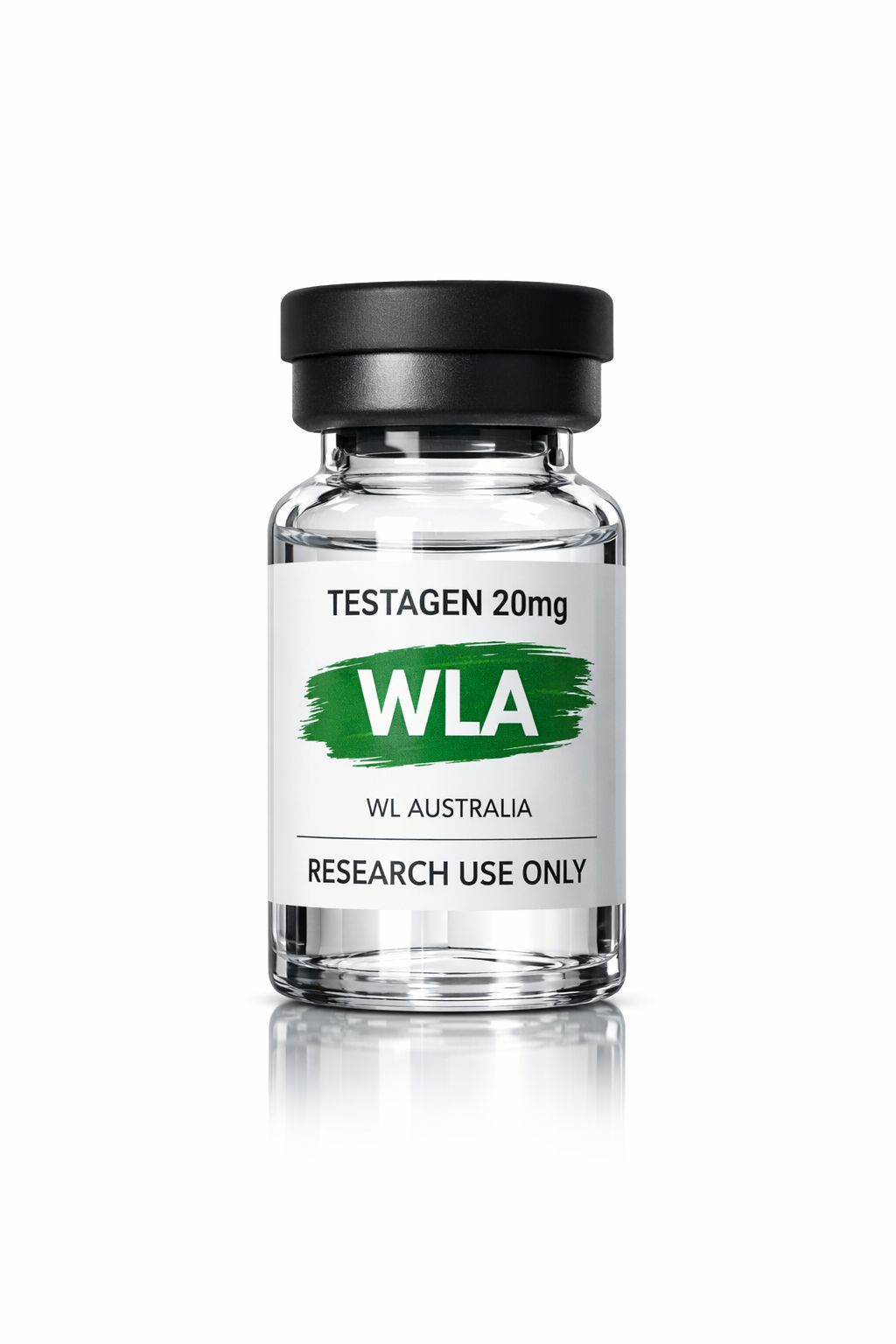
Testagen 20mg is described as KEDG, a short synthetic signalling peptide. The product information positions it around:
- Male reproductive function
- Testicular cellular signalling
- Testosterone-related gene expression
- Libido, stamina and vitality research
The crucial point is that Testagen is not testosterone itself. It is presented as a signalling compound rather than a direct hormone replacement.
That does not make it automatically safe or effective. The product page identifies it as a research chemical, and robust, independently replicated human evidence is limited. Claims involving testosterone, mood, stamina or fertility should therefore be considered preliminary.
If you have symptoms that suggest low testosterone, you should first discuss them with a qualified clinician. A proper evaluation may include morning testosterone testing, repeat testing where appropriate, luteinising hormone (LH), follicle-stimulating hormone (FSH), thyroid markers and other relevant investigations.
Practical summary: Testagen is the most testis-focused option, but it also carries the greatest need for caution because its human evidence and long-term safety profile are not well established.
Direct comparison table
| Feature | Prostatilen | Libidon | Testagen |
|---|---|---|---|
| Main target | Prostate | Prostate and pelvic reproductive system | Testicular tissue |
| Listed composition | Bovine prostate-derived polypeptide complex | A-16 bovine prostate amino acid complex | Synthetic peptide KEDG |
| Main research focus | Prostate inflammation, urinary function and pelvic support | Prostate structure, cellular metabolism and reproductive wellness | Testosterone-related signalling and testicular function |
| Direct testosterone replacement? | No | No | No |
| Human evidence | Older clinical research exists | Limited and less independently replicated | Limited and exploratory |
| Key concern | Product formulation and route may differ from older studies | Evidence quality and supplement-style claims | Limited human and long-term safety data |
| Best conceptual fit | Prostate-centred research | Prostate plus reproductive support research | Testicular or hormone-signalling research |
Do not compare the milligram numbers as though they are interchangeable. A 10mg peptide complex and a 20mg synthetic peptide are different materials with different compositions. More milligrams does not mean stronger, safer or more effective.
Video placeholder 1: Embed a clinician-led explainer comparing prostate tissue, testes and the HPG axis here.
Which one fits the research question?
If the main concern is urinary or prostate-related
Your first priority should be medical evaluation. Blood in the urine or semen, fever, severe pelvic pain, sudden urinary retention or significant urinary difficulty should not be managed with an experimental product.
From a research-target perspective, Prostatilen and Libidon are the two prostate-centred options. Prostatilen has a more visible history of published clinical research, while Libidon is described as a targeted A-16 complex with a broader reproductive-wellness focus.
If the main concern is testosterone or testicular function
You should establish a baseline before considering any research compound. That means discussing symptoms, medications, sleep, alcohol intake, body composition and laboratory testing with a clinician.
From a target perspective, Testagen is the testicular option. It should not be confused with testosterone replacement therapy (TRT), and it should not be used to self-treat suspected hypogonadism.
If fertility is the main concern
Fertility requires more than a testosterone measurement. A semen analysis, reproductive history and clinical assessment are often important. Sperm production takes time, so short-term changes in libido do not necessarily indicate improved fertility.
Do not combine several reproductive products simply because their names appear complementary. In biology, synergy means coordinated action: not automatically stacking more compounds.
Safety, sourcing and Australian context
The problem: confusing a product listing with therapeutic approval
A product being available online does not mean it is approved as a medicine in Australia. Research chemicals may not have the same quality controls, clinical evidence, dosage standards or post-market monitoring as approved therapeutic goods.
The solution: use a measured, supervised approach
Before considering any research compound:
- Speak with a qualified Australian healthcare professional.
- Check for prostate symptoms and appropriate screening, including prostate-specific antigen (PSA) where clinically indicated.
- Discuss testosterone, LH and FSH testing if hormonal symptoms are present.
- Ask about allergies, especially where bovine-derived materials are involved.
- Review anticoagulants, antiplatelet medicines and other prescriptions.
- Do not use a research chemical in place of treatment for infection, BPH, cancer, infertility or hormonal disease.
- Avoid products marketed with guaranteed claims about testosterone, fertility or sexual performance.
Video placeholder 2: Embed a product-quality and laboratory-testing explainer here, covering certificates of analysis, storage and responsible research handling.
Final verdict
Prostatilen, Libidon and Testagen are not interchangeable.
- Choose Prostatilen as the most prostate-specific research concept, with some older published human research but important formulation limitations.
- Consider Libidon as another prostate-focused peptide complex, with claims extending into male reproductive wellness but a more limited independent evidence base.
- View Testagen as the testicular and testosterone-signalling research option, with the greatest need for caution because long-term human data are limited.
The most responsible strategy is simple: identify the real problem, establish a medical baseline, choose quality and transparency, and monitor your results. That is how you support recovery, synergy and optimisation without turning male health into guesswork.
Explore the full bioregulator range at WL Australia or read our earlier guide, Libidon vs Testagen: Comparing Male Reproductive and Testicular Bioregulators, for additional background.

 Immune Support and Life Extension
 Shop Bioregulators & Research Chemicals for 2026 Scientific Labs
 Brain
Brain Buy Hair & Skin Care Peptides Australia – Top Quality & Best Prices
 Discover WLAustralia Peptides for Anxiety Relief & Longevity