PE-22-28: The TREK-1 Inhibitor for Mood, Memory, and Neurogenesis

If you have ever felt like your brain is stuck in a low-power mode, you are not alone. When mood slips or memory becomes foggy, it often feels like a biological "leak" is draining your cognitive resources. Traditional approaches often try to force more "power" into the system, but what if the solution was as simple as plugging the leak?
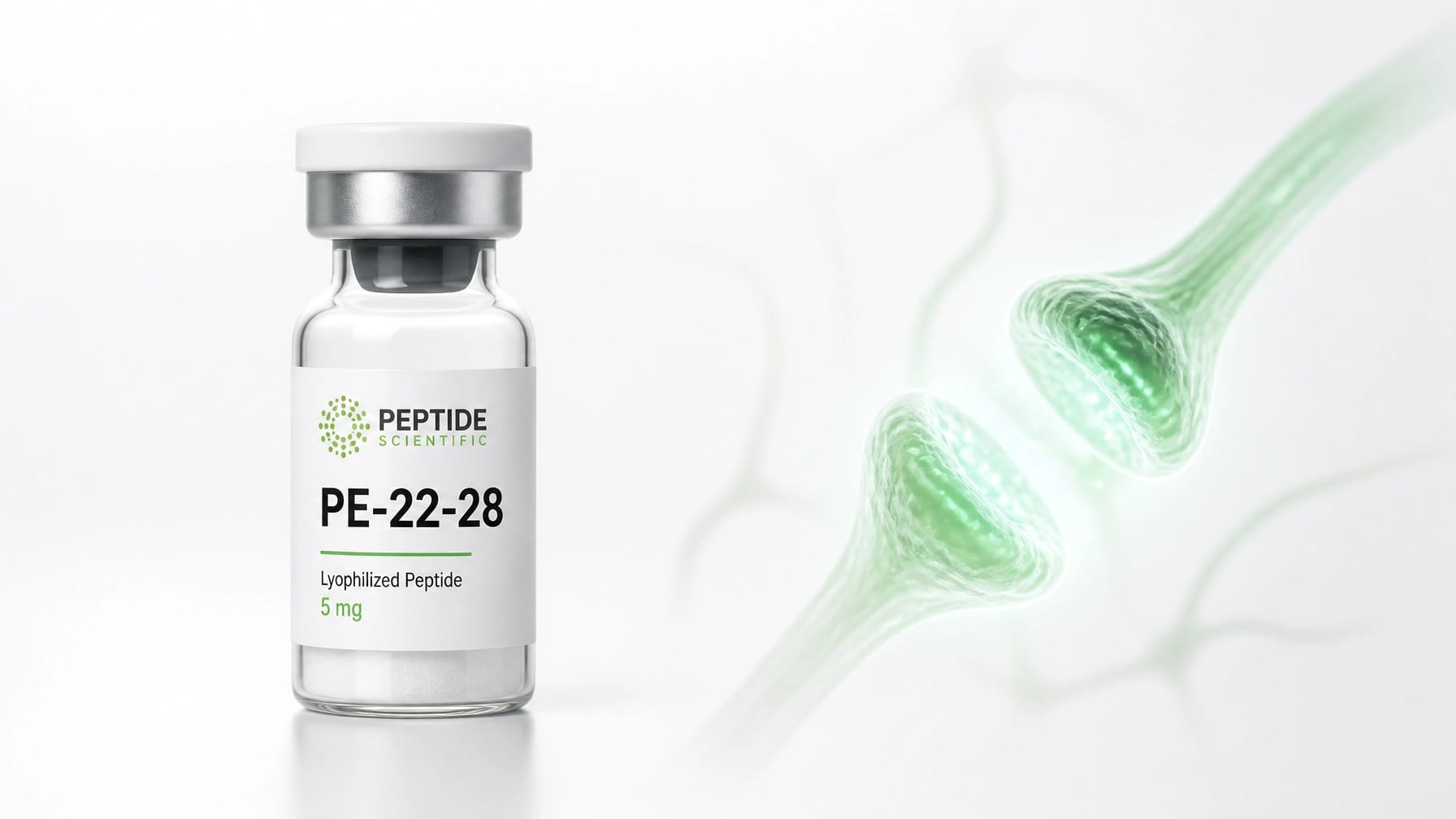
Enter PE-22-28. This novel peptide is a refined version of a naturally occurring molecule called Spadin. While Spadin was a breakthrough in neuroscience, PE-22-28 is the high-performance upgrade. It targets a specific gateway in your brain cells called the TREK-1 channel, acting as a selective "inhibitor" to restore balance to your neural firing and trigger the growth of new brain cells.
In this guide, you will learn how this seven-amino-acid chain is redefining the landscape of neurogenesis and why it is becoming a focal point for those interested in cutting-edge mood support and cognitive repair.
The Problem: The Brain's "Pressure Relief Valve"
To understand PE-22-28, consider your neurons as a complex plumbing system. For a signal to travel, the "water pressure" (electrical charge) must build up until the neuron fires. However, your brain has safety valves called TREK-1 potassium channels. These channels allow potassium to leak out of the cell, which lowers the pressure and prevents the neuron from firing too easily.
In a healthy brain, this is a necessary safety feature. But in cases of chronic stress or low mood, these valves can become "stuck open." When too much potassium leaks out, your neurons become hyperpolarized: essentially, they become too "quiet" and difficult to activate. This leads to the sluggishness, lack of motivation, and cognitive "heaviness" associated with various mood disorders.
The Solution: PE-22-28 acts as a custom-fitted "plug" for these TREK-1 valves. By selectively inhibiting these channels, PE-22-28 keeps the "pressure" where it belongs, making it easier for your neurons to fire and communicate. This process is known as TREK-1 inhibition, and in preclinical models, it has shown the potential to produce rapid antidepressant-like effects without the long wait times associated with traditional supplements.
The Spadin Evolution: Faster, Stronger, Longer
PE-22-28 was not invented in a vacuum. It was derived from Spadin, a 17-amino-acid peptide that naturally interacts with the sortilin receptor in the brain. Researchers discovered that they could strip Spadin down to its most active core: just 7 amino acids: to create PE-22-28.
Consider this the difference between a bulky old-school radiator and a modern, high-efficiency heat pump. Because it is smaller and more refined, PE-22-28 possesses a much higher affinity for its target. In scientific terms, it has an IC50 of approximately 0.12 nM. This means it takes a tiny amount of the peptide to achieve a massive effect on the TREK-1 channel.
| Feature | Spadin (Parent Peptide) | PE-22-28 (The Evolution) |
|---|---|---|
| Size | 17 Amino Acids | 7 Amino Acids |
| Potency (IC50) | 40–60 nM | ~0.12 nM (Highly Potent) |
| Duration of Action | ~7 Hours | ~23 Hours |
| Selectivity | High | Ultra-High |
As the table shows, one of the most significant advantages for the user is the duration of action. While Spadin only stays active for about 7 hours, PE-22-28 remains effective for nearly a full day. This "once-daily" biological profile makes it far more practical for long-term neural optimization.

Unlocking Neurogenesis: Rebuilding the Hippocampus
The most exciting aspect of PE-22-28 isn't just how it changes your mood today, but how it "reforms" your brain for tomorrow. This is where we talk about neurogenesis: the birth of new neurons.
Focus on the hippocampus, the area of your brain responsible for emotion and memory. Preclinical studies have shown that inhibiting the TREK-1 channel triggers a cascade of growth factors, most notably BDNF (Brain-Derived Neurotrophic Factor). Think of BDNF as "miracle-gro" for your brain. It encourages existing neurons to survive and stimulates the production of new ones (measured by BrdU incorporation in research).
Furthermore, PE-22-28 enhances synaptogenesis. It increases the expression of PSD-95, a protein that acts as the "scaffolding" for new synaptic connections. By building more robust bridges between neurons, the peptide helps repair the structural damage caused by chronic stress and biological aging.
If you are exploring our Nootropics Collection, understanding this "repair-first" mechanism is key to moving beyond temporary stimulants and toward true biological optimization.
Synergy and Performance: The 23-Hour Window
Because PE-22-28 has an extended half-life, it creates a "window of plasticity" that lasts nearly 23 hours. This makes it an ideal candidate for pairing with cognitive tasks or therapy. When your brain is in this state of heightened neuroplasticity, the "lessons" you learn and the habits you form are more likely to "stick."
Consider this synergy:
- The Lead: PE-22-28 plugs the TREK-1 leak and raises BDNF levels.
- The Action: You engage in focused work, meditation, or learning.
- The Result: The new synaptic "scaffolding" (PSD-95) locks those improvements into place.
For those interested in managing the physical side effects of mental fatigue, you might also consider how this fits into a broader stack, such as pairing it with specialized delivery tools like a Nasal Spray Kit for efficient administration.

Safety and Regional Context
While the preclinical data is incredibly promising: showing significant reductions in "immobility" (a marker for despair) and faster "feeding latency" (a marker for confidence): it is vital to ground these findings in responsibility.
In Australia, peptides like PE-22-28 are currently categorized as research chemicals. This means that while they are at the forefront of neuroscience, they have not yet undergone large-scale human clinical trials. You must treat these compounds with the respect they deserve as potent biological modifiers.
Practical Safety Checklist:
- Source Quality: Ensure your peptides are sourced from reputable providers like wlaustralia to guarantee purity.
- Oversight: Always discuss novel peptides with a healthcare professional, especially if you are currently taking medications for mood or anxiety.
- Incremental Approach: Start with the foundational principles of health (sleep, diet, and exercise) before adding high-potency "plugs" like TREK-1 inhibitors to your routine.
Take Control of Your Biology
The discovery of PE-22-28 represents a shift away from "carpet-bombing" the brain with neurotransmitters and toward a more surgical, mechanical approach. By selectively blocking the TREK-1 channel, we can stop the "leak" of potential and provide the brain with the stability it needs to heal itself.
Whether you are looking to support your mood or accelerate your cognitive recovery, PE-22-28 offers a unique, long-lasting path toward neurogenesis. The future of brain health isn't about working harder; it's about making your biology work smarter.


 Immune Support and Life Extension
 Shop Bioregulators & Research Chemicals for 2026 Scientific Labs
 Brain
Brain Buy Hair & Skin Care Peptides Australia – Top Quality & Best Prices
 Discover WLAustralia Peptides for Anxiety Relief & Longevity